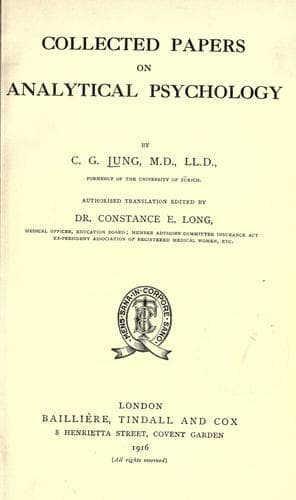
Collected Papers on Analytical PsychologyJung, C. G. (Carl Gustav)
Science
Collected Papers on Analytical Psychology
Jung, C. G. (Carl Gustav)
Psychoanalysis
Time does not allow me to describe the technique by means of which I
succeeded in lifting the veil of her secret. I must content myself by
giving a few examples to make the strange changes of thought and of
speech in this patient clear to you.
She said of herself that _she was Socrates_. The analysis of this
delusion presented the following ideas: Socrates was the wisest man,
the man of greatest learning; he was infamously accused, and had to die
in prison at the hands of strange men. She was the best dressmaker, but
"never unnecessarily cut a thread, and never allowed a piece of material
to lie about on the floor." She worked ceaselessly, and now she has been
falsely accused, wicked men have shut her up, and she will have to die
in the asylum.
Therefore she is Socrates; this is, as you see, simple metaphor, based
upon obvious analogy. Take another example: "_I am the finest professor
and the finest artist in the world._"
The analysis furnishes the remarks that she is the best dressmaker and
chooses the most beautiful models which show up well and waste little
material; she puts on the trimming only where it can be seen. She is a
professor, and an artist in her work. She makes the best clothes and
calls them absurdly "The Schnecke Museum-clothes." Her customers are
only such persons as frequent the Schnecke House and the Museum (the
Schnecke House is the aristocratic club. It is near the Museum and the
Library, another rendezvous of the aristocratic set of Zürich), for she
is the best dressmaker and makes only Schnecke Museum[200] clothing.
The patient also _calls herself Mary Stuart_. Analysis showed the same
analogy as with Socrates: innocent suffering and death of a heroine.
"_I am the Lorelei._" Analysis: This is an old and well-known song: "I
know not what it means," etc. Whenever she wants to speak about her
affairs people do not understand her, and say they don't know what it
means; hence she is the Lorelei.
"_I am Switzerland._" Analysis: Switzerland is free, no one can rob
Switzerland of her freedom. The patient does not belong to the asylum,
she would be free like Switzerland, hence she is Switzerland.
"_I am a crane._" Analysis: In the "Cranes of Ibykus" it is said:
"Whosoever is free of sin and fault shall preserve the pure soul of
a child." She has been brought innocent to the asylum and has never
committed a crime--hence she is a crane.
"_I am Schiller's Bell._" Analysis: Schiller's Bell is the greatest work
of the great master. She is the best and most industrious dressmaker,
and has achieved the highest rung in the art of dressmaking--hence she
is Schiller's Bell.
"_I am Hufeland._" Analysis: Hufeland was the best doctor. She suffers
intolerably in the asylum and is moreover treated by the worst doctors.
She is, however, so prominent a personality that she had a claim to the
best doctors, that is to a doctor like Hufeland--hence she is Hufeland.
Public-domain text, read in full here on John Shaqi.
Reviews
Reviews
No reviews yet
Be the first to share your thoughts on this work.
Elsewhere in the archive
Join the Discussion
Join the discussion
Sign in to leave a comment or review.
Sign InorCreate an account