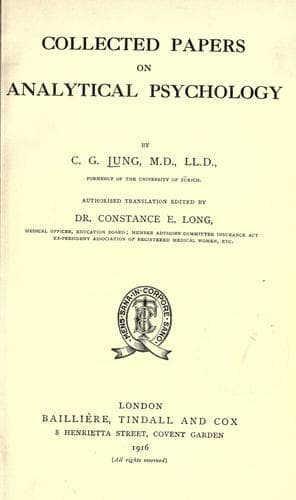
Collected Papers on Analytical PsychologyJung, C. G. (Carl Gustav)
Science
Collected Papers on Analytical Psychology
Jung, C. G. (Carl Gustav)
Psychoanalysis
Medical experience has taught us that there are two large groups of
functional nervous disorders. The one embraces all those forms of
disease which are designated _hysterical_, the other all those forms
which the French school has designated _psychasthenic_. Although
the line of demarcation is rather uncertain, one can mark off two
psychological types which are obviously different; their psychology
is diametrically opposed. I have called these--the _Introverted_ and
_Extroverted_ types. The hysteric belongs to the type of _Extroversion_,
the psychasthenic to the type of _Introversion_, as does dementia
præcox, in so far as we know it to-day. This terminology, _Introversion_
and _Extroversion_, is bound up with my way of regarding mental
phenomena as forms of energy. I postulate a hypothetical fundamental
striving which I designate _libido_.[213] In the classical use of the
word, _libido_ never had an exclusively sexual connotation as it has in
medicine. The word _interest_, as Claparède once suggested to me, could
be used in this special sense, if this expression had to-day a less
extensive application. Bergson's concept, _élan vital_, would also serve
if this expression were less biological and more psychological. Libido
is intended to be an energising expression for _psychological values_.
The psychological value is something active and determining; hence it
can be regarded from the energic standpoint without any pretence of
exact measurement.
The introverted type is characterised by the fact that his libido
is turned towards his own personality to a certain extent--he finds
within himself the unconditioned value. The extroverted type has his
libido to a certain extent externally; he finds the unconditioned value
outside himself. The introvert regards everything from the aspect of
his own personality; the extrovert is dependent upon the value of his
object. I must emphasise the statement that this question of types is
_the_ question of our psychology, and that every further advance must
probably proceed by way of this question. The difference between these
types is almost alarming in extent. So far there is only one small
preliminary communication by myself[214] on this theory of type, which
is particularly important for the conception of dementia præcox. On the
psychiatric side Gross[215] has called attention to the existence of two
psychological types. His two types are (1) those with limited but deep
consciousness, and (2) those with broad but superficial consciousness.
The former correspond to my introverted and the latter to my extroverted
type. In my article I have collected some other instances among which
I would especially call attention to the striking description of the
two types given by William James in his book on "Pragmatism." Fr. Th.
Vischer has differentiated the two types very wittily by her division of
the learned into "reason-mongers," and "matter-mongers." In the sphere
Public-domain text, read in full here on John Shaqi.
Reviews
Reviews
No reviews yet
Be the first to share your thoughts on this work.
Elsewhere in the archive
Join the Discussion
Join the discussion
Sign in to leave a comment or review.
Sign InorCreate an account