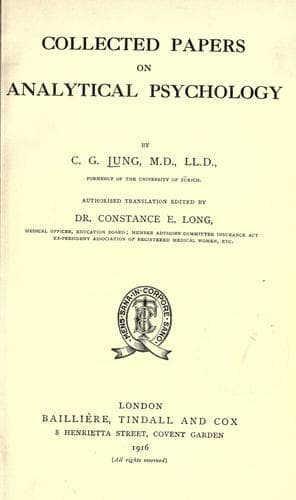
Collected Papers on Analytical PsychologyJung, C. G. (Carl Gustav)
Science
Collected Papers on Analytical Psychology
Jung, C. G. (Carl Gustav)
Psychoanalysis
I must now again point out that it is an obstinate, scholastic
misunderstanding not to be able to distinguish between a
world-philosophy which is only psychological, and an extra-psychological
theory, which concerns the objective thing. It is absolutely essential
that the student of the results of the constructive method should be
able to draw this distinction. In its first results the constructive
method does not produce anything that could be called a scientific
theory; it furnishes the _psychological lines of development_, a _path_
so to say. I must here refer the reader to my book, "Psychology of the
Unconscious."
The analytic reductive method has the advantage of being much simpler
than the constructive method. The former reduces to well-known universal
elements of an extremely simple nature. The latter has, with extremely
complicated material, to construct the further path to some often
unknown end. This obliges the psychologist to take full account of
all those forces which are at work in the human mind. The reductive
method strives to replace the religious and philosophical needs of man,
by their more elementary components, following the principle of the
"nothing but," as James so aptly calls it. But to _construct_ aright,
we must accept the developed aspirations as indispensable components,
essential elements, of spiritual growth. Such work extends far beyond
empirical concepts but that is in accordance with the nature of the
human soul which has never hitherto rested content with experience
alone. Everything new in the human mind proceeds from speculation.
Mental development proceeds by way of speculation, never by way of
limitation to mere experience. I realise that my views are parallel
with those of Bergson, and that in my book the concept of the libido
which I have given, is a concept parallel to that of "élan vital"; my
constructive method corresponds to Bergson's "intuitive method." I,
however, confine myself to the psychological side and to practical work.
When I first read Bergson a year and a half ago I discovered to my great
pleasure everything which I had worked out practically, but expressed by
him in consummate language and in a wonderfully clear philosophic style.
Public-domain text, read in full here on John Shaqi.
Reviews
Reviews
No reviews yet
Be the first to share your thoughts on this work.
Elsewhere in the archive
Join the Discussion
Join the discussion
Sign in to leave a comment or review.
Sign InorCreate an account