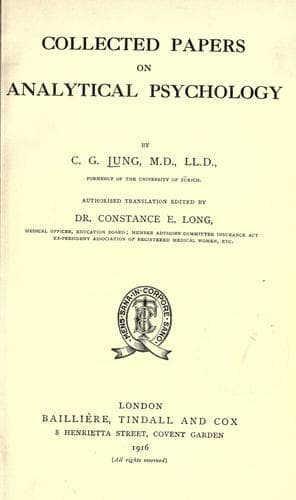
Collected Papers on Analytical PsychologyJung, C. G. (Carl Gustav)
Science
Collected Papers on Analytical Psychology
Jung, C. G. (Carl Gustav)
Psychoanalysis
1. _Automatic Movements of the Table._--Before the patient came
under my observation she had been influenced by the suggestion of
"table-turning," which she had first come across as a game. As soon as
she entered the circle there appeared communications from members of
her family which showed her to be a medium. I could only find out that,
as soon as ever her hand was placed on the table, the typical movements
began. The resulting communications have no interest for us. But the
automatic character of the act itself deserves some discussion, for
we may, without more ado, set aside the imputation that there was any
question of intentional and voluntary pushing or pulling on the part of
the patient.
As we know from the investigations of Chevreul,[27] Gley, Lehmann
and others, unconscious motor phenomena are not only of frequent
occurrence among hysterical persons, and those pathologically inclined
in other directions, but they are also relatively easily produced in
normal persons who show no other spontaneous automatisms. I have made
many experiments on these lines, and can confirm this observation.
In the great majority of instances all that is required is enough
patience to put up with an hour of quiet waiting. In most subjects,
motor automatisms will be obtained in a more or less high degree if
contra-suggestions do not intervene as obstacles. In a relatively small
percentage the phenomena arise spontaneously, _i.e._ directly under
the influence of verbal suggestion or of some earlier auto-suggestion.
In this instance the case is powerfully affected by suggestion. In
general, the particular predisposition is subject to all those laws
which also hold good for normal hypnosis. Nevertheless, certain
special circumstances are to be taken into account, conditioned by the
peculiarity of the case. It is not a question of a total hypnosis, but
of a partial one, limited entirely to the motor area of the arm, like
the cerebral anæsthesia produced by "magnetic passes" for a painful spot
in the body. We touch the spot in question employing verbal suggestion
or making use of some existing auto-suggestion, using the tactile
stimulus which we know acts suggestively, to bring about the desired
partial hypnosis. In accordance with this procedure, refractory subjects
can be brought easily enough to an exhibition of automatism. The
experimenter intentionally gives the table a slight push, or, better, a
series of rhythmic but very slight taps. After a short time he notices
that the oscillations become stronger, that they continue although
he has interrupted his own intentional movements. The experiment has
succeeded, the subject has unsuspectingly taken up the suggestion. By
this procedure much more is obtained than by verbal suggestion. In very
receptive persons and in all those cases where movement seems to arise
spontaneously, the purposeful tremulous movements,[28] not perceptible
by the subject, assume the _rôle_ of _agent provocateur_.
Public-domain text, read in full here on John Shaqi.
Reviews
Reviews
No reviews yet
Be the first to share your thoughts on this work.
Elsewhere in the archive
Join the Discussion
Join the discussion
Sign in to leave a comment or review.
Sign InorCreate an account