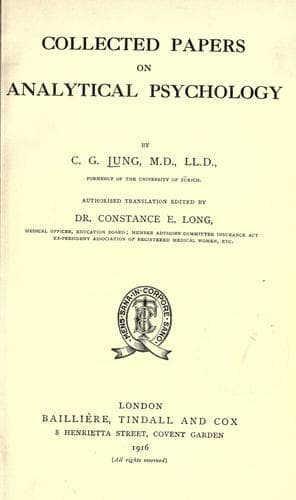
Collected Papers on Analytical PsychologyJung, C. G. (Carl Gustav)
Science
Collected Papers on Analytical Psychology
Jung, C. G. (Carl Gustav)
Psychoanalysis
In this way persons who, by themselves, have never obtained automatic
movements of a coarse calibre, sometimes assume the unconscious guidance
of the table-movements, provided that the tremors are strong and that
the medium understands their meaning. In this case the medium takes
control of the slight oscillations and returns them considerably
strengthened, but rarely at exactly the same instant, generally a
few seconds later, in this way revealing the agent's conscious or
unconscious thought. By means of this simple mechanism there may arise
those cases of thought-reading so bewildering at first sight. A very
simple experiment, that succeeds in many cases even with unpractised
persons, will serve to illustrate this. The experimenter thinks, say,
of the number _four_, and then waits, his hands quietly resting on
the table, until he feels that the table makes the first inclination
to announce the number thought of. He lifts his hands off the table
immediately, and the number _four_ will be correctly tilted out. It
is advisable in this experiment to place the table upon a soft thick
carpet. By close attention the experimenter will occasionally notice a
movement of the table which is thus represented.
[Illustration: FIG. 2.]
(1) Purposeful tremors too slight to be perceived by the subject.
(2) Several very small but perceptible oscillations of the table which
indicate that the subject is responding to them.
(3) The big movements (tilts) of the table, giving the number four that
was thought of.
(_ab_) Denotes the moment when the operator's hands are removed.
This experiment succeeds excellently with well-disposed but
inexperienced subjects. After a little practice the phenomenon indicated
is wont to disappear, since by practice the number is read and
reproduced directly from the purposeful movements.[29]
In a responsive medium these purposeful tremors of the experimenter
act just as the intentional taps in the experiment cited above; they
are received, strengthened and reproduced, although slightly wavering.
Still they are perceptible and hence act suggestively as slight tactile
stimuli, and by the increase of partial hypnosis give rise to great
automatic movements. This experiment illustrates in the clearest way
the increase step by step of auto-suggestion. Along the path of this
auto-suggestion are developed all the automatic phenomena of a motor
nature. How the intellectual content gradually mingles in with the
purely motor need scarcely be elucidated after this discussion. There
is no need of a special suggestion for the evoking of intellectual
phenomena. From the outset it is a question of word-presentation, at
least from the side of the experimenter. After the first aimless motor
irrelevancies of the unpractised subject, some word-products or the
intentions of the experimenter are soon reproduced. Objectively the
occurrence of an intellectual content must be understood as follows:--
Public-domain text, read in full here on John Shaqi.
Reviews
Reviews
No reviews yet
Be the first to share your thoughts on this work.
Elsewhere in the archive
Join the Discussion
Join the discussion
Sign in to leave a comment or review.
Sign InorCreate an account