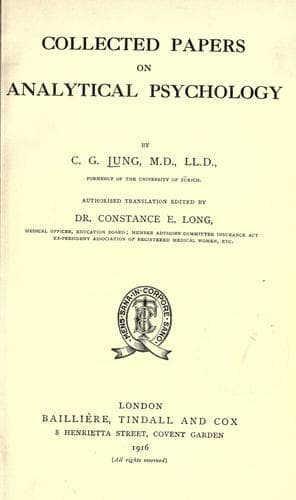
Collected Papers on Analytical PsychologyJung, C. G. (Carl Gustav)
Science
Collected Papers on Analytical Psychology
Jung, C. G. (Carl Gustav)
Psychoanalysis
this is parallel to the experiences revealed by dream investigation
(Freud's[41]) must remain undecided, for we have no means of judging how
far the effect mentioned can be considered a "repressed" one. From the
brusque interruption of the new personality, we may conclude that the
presentations concerned were very vivid, with corresponding intensity
of expectation. This perhaps was an attempt to overcome a certain
maidenly shyness and embarrassment. This event reminds us vividly of the
manner in which the dream presents to consciousness, by a more or less
transparent symbolism, things one has never said to oneself clearly and
openly. We do not know when this dissociation of the new personality
occurred, whether it had been slowly prepared in the unconscious,
or whether it first occurred in the séance. In any case, this event
meant a considerable increase in the extension of the unconscious
sphere rendered accessible through the hypnosis. At the same time
this event must be regarded as powerfully suggestive in regard to the
impression which it made upon the waking consciousness of the patient.
For the perception of this unexpected intervention of a new power must
inevitably excite a feeling of the strangeness of the automatisms,
and would easily suggest the thought that an independent spirit is
here making itself known. Hence the intelligible association that she
would finally be able to see this spirit. The situation that ensued
at the second séance is to be explained by the coincidence of this
energising suggestion with the heightened suggestibility conditioned
by the darkness. The hypnosis, and with it the series of dissociated
presentations, break through to the visual area, and the expression of
the unconscious, hitherto purely motor, is made objective, according
to the measure of the specific energy of the new system, in the shape
of visual images with the character of hallucinations; not as a mere
accompanying phenomenon of the word-automatism, but as a substituted
function. The explanation of the situation that arose in the first
séance, at that time unexpected and inexplicable, is no longer presented
in words, but as a descriptive allegorical vision. The sentence "they
do not hate one another, but are friends," is expressed in a picture.
We often encounter events of this kind in somnambulism. The thinking of
somnambulists is given in plastic images which constantly break into
this or that sense-sphere and are made objective in hallucinations. The
process of reflection sinks into the subconscious; only its end-results
arise to consciousness either as presentations vividly tinged by the
senses, or directly as hallucinations. In our case the same thing
occurred as in the patient whose anæsthetic hand Binet pricked nine
times, making her think of the figure 9; or as in Flournoy's[42] Helen
Smith, who, when asked during business-hours about certain patterns,
suddenly saw the number of days (18) for which they had been lent, at
Public-domain text, read in full here on John Shaqi.
Reviews
Reviews
No reviews yet
Be the first to share your thoughts on this work.
Elsewhere in the archive
Join the Discussion
Join the discussion
Sign in to leave a comment or review.
Sign InorCreate an account