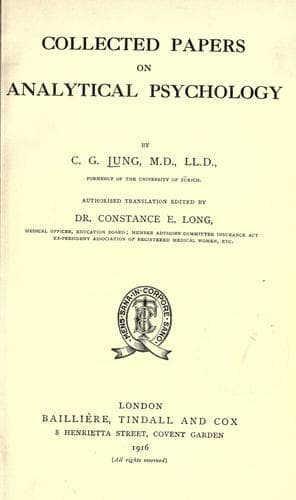
Collected Papers on Analytical PsychologyJung, C. G. (Carl Gustav)
Science
Collected Papers on Analytical Psychology
Jung, C. G. (Carl Gustav)
Psychoanalysis
a length of 20 mm. in front of her. The further question arises, why
does the automatism appear in the visual and not in the acoustic sphere?
There are several grounds for this choice of the visual sphere.
(1) The patient is not gifted acoustically; she is, for instance, very
unmusical.
(2) There was no stillness corresponding to the darkness which might
have favoured the appearance of sounds; there was a lively conversation.
(3) The increased conviction of the near presence of spirits, because
the automatism felt so strange, could easily have aroused the idea that
a spirit might be seen, thus causing a slight excitation of the visual
sphere.
(4) The entoptic phenomena in darkness favoured the occurrence of
hallucinations.
The reasons (3) and (4)--the entoptic phenomena in the darkness and the
probable excitation of the visual sphere--are of decisive importance
for the appearance of hallucinations. The entoptic phenomena in this
case play the same rôle in the auto-suggestion, the production of
the automatism, as the slight tactile stimuli in hypnosis of the
motor centre. As stated, flashes preceded the first hallucinatory
twilight-state. Obviously attention was already at a high pitch, and
directed to visual perceptions, so that the retina's own light, usually
very weak, was seen with great intensity. The part played by entoptic
perceptions of light in the origin of hallucinations deserves further
consideration. Schüle[43] says: "The swarming of light and colour which
stimulates and animates the field of vision, although in the dark,
supplies the material for phantastic figures in the air before falling
asleep. As we know, absolute darkness is never seen; a few particles
of the dark field of vision are always illumined; flecks of light move
here and there, and combine into all kinds of figures; it only needs a
moderately active imagination to create out of them, as one does out
of clouds, certain known figures. The power of reasoning, fading as one
falls asleep, leaves phantasy free play to construct very vivid figures.
In the place of the light spots, haziness and changing colours of the
dark visual field, there arise definite outlines of objects."[44]
In this way hypnagogic hallucinations arise. The chief _rôle_ naturally
belongs to the imagination, hence imaginative people in particular are
subject to hypnagogic hallucinations.[45] The hypnopompic hallucinations
described by Myers arise in the same way.
Public-domain text, read in full here on John Shaqi.
Reviews
Reviews
No reviews yet
Be the first to share your thoughts on this work.
Elsewhere in the archive
Join the Discussion
Join the discussion
Sign in to leave a comment or review.
Sign InorCreate an account