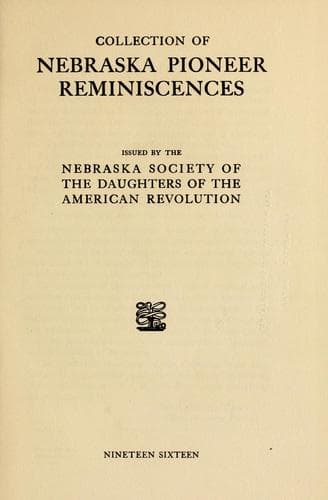
Collection of Nebraska Pioneer ReminiscencesDaughters of the American Revolution. Nebraska
History
Collection of Nebraska Pioneer Reminiscences
Daughters of the American Revolution. Nebraska
Frontier and pioneer life -- Nebraska; Nebraska -- History
In the early days of my hotel experience, I was offered some cabbages by
a farmer boy--rather a reserved and studious looking lad. He raised good
cabbages on his father's homestead a few miles north of town. After
dickering awhile over the price, I took his entire load. He afterwards
said that I beat him down below cost of production, and then cleaned him
out, while I insisted that he had a monopoly and the price of cabbages
should have been regulated by law. Soon after, I was surprised to find
him in my room taking an examination for a teacher's certificate, my
room-mate being the county superintendent, and rather astonished, I
said, "What! you teach school?"--a remark he never forgot. He read law
with Slocumb & Hambel, was some time afterwards elected county attorney
and later judge of this district. Ten years ago he was elected one of
the judges of the supreme court of the state of Nebraska, and this
position he still fills with distinguished ability. I scarcely need to
mention that this was Charles B. Letton.
A celebration was held on July 4, 1871, at Mattingly's sawmill, and
enthusiasm and patriotism were greatly stimulated by the blowing of a
steam whistle which had recently been installed in the mill. Colonel
Thomas Harbine, vice-president of the St. Joseph & Denver City R. R.
Co., now the St. Joseph & Grand Island railroad, made the principal
address, his subject being "The railroad, the modern civilizer, may we
hail its advent." The Otoe Indian, Jim Whitewater, got drunk at this
celebration, and on his way to the reservation murdered two white men
who were encamped near Rock creek. He was arrested by the Indians,
brought to Fairbury, and delivered to the authorities, after which chief
Pipe Stem and chief Little Pipe visited the _Gazette_ office and watched
the setting of type and printing on the press with many a grunt of
satisfaction. I was present at the trial of Whitewater the following
spring. After the verdict of guilty was brought in, Judge O. P. Mason
asked him if he had anything to say why judgment should not be
pronounced. Whitewater proceeded to make a lengthy speech, ridiculed the
former sheriff, S. J. Alexander, and commenced criticizing the judge.
The judge ordered him to sit down. A look of livid rage came over
Whitewater's face, and he stooped slightly as though to spring. Then the
judge turned pale, and in that rasping voice which all who knew him
remember well, commanded the sheriff to seat the prisoner, which was
done.
The spring of 1872 marked a new era in the life of Fairbury. On March
13th of that year the St. Joseph and Denver City railroad built into and
through our city. From the time the track-layers struck Jenkin's Mills,
a crowd of us went down every day to see the locomotive and watch the
progress of the work. One of our fondest dreams had come true.
Public-domain text, read in full here on John Shaqi.
Reviews
Reviews
No reviews yet
Be the first to share your thoughts on this work.
Elsewhere in the archive
Join the Discussion
Join the discussion
Sign in to leave a comment or review.
Sign InorCreate an account