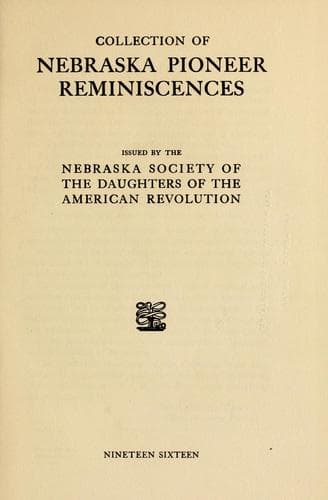
Collection of Nebraska Pioneer ReminiscencesDaughters of the American Revolution. Nebraska
History
Collection of Nebraska Pioneer Reminiscences
Daughters of the American Revolution. Nebraska
Frontier and pioneer life -- Nebraska; Nebraska -- History
Spring opened very early in the year 1873. Farmers plowed and harrowed
the ground and sowed their oats and spring wheat in February and March.
The grass began to grow early in April and by the middle of the month
the small-grain fields were bright green with the new crops. Most of the
settlers on the uplands of Jefferson county were still living in dugouts
or sod houses. The stables and barns for the protection of their live
stock were for the most part built by setting forked posts in the
ground, putting rough poles and brush against the sides and on the roof,
and covering them with straw, prairie grass, or manure. Sometimes the
bank of a ravine was made perpendicular and used as one side. The
covering of the walls and roof of these structures needed continual
renewal as the winds loosened it or as the spring rains caused it to
settle. Settlers became careless about this early in the spring,
thinking that the winter was over. The prairies were still bare of
hedges, fences, or trees to break the winds or catch the drifting snow.
Easter Sunday occurred on the thirteenth of April. For days before, the
weather had been mild and the air delightful. The writer was then living
alone in a dugout seven miles north of Fairbury in what is now the rich
and fertile farming community known as Bower. The granary stood on the
edge of a ravine a short distance from the dugout. The stable or barn
was partly dug into the bank of this ravine; the long side was to the
north, while the roof and the south side were built of poles and straw
in the usual fashion of those days. On the afternoon of Easter Sunday it
began to rain and blow from the northwest. The next morning I had been
awake for some time waiting for daylight when I finally realized that
the dim light coming from the windows was due to the fact that they were
covered with snow drifts. I could hear the noise of the wind but had no
idea of the fury of the tempest until I undertook to go outside to feed
the stock. As soon as I opened the door I found that the air was full
of snow, driven by a tremendous gale from the north. The fury of the
tempest was indescribable. The air appeared to be a mass of moving snow,
and the wind howled like a pack of furies. I managed to get to the
granary for some oats, but on looking into the ravine no stable was to
be seen, only an immense snow drift which almost filled it. At the point
where the door to the stable should have been there appeared a hole in
the drift where the snow was eddying. On crawling into this I found that
during the night the snow had drifted in around the horses and cattle,
which were tied to the manger. The animals had trampled it under their
feet to such an extent that it had raised them so that in places their
backs lifted the flimsy roof, and the wind carrying much of the covering
away, had filled the stable with snow until some of them were almost and
others wholly buried, except where the remains of the roof protected
them.
Public-domain text, read in full here on John Shaqi.
Reviews
Reviews
No reviews yet
Be the first to share your thoughts on this work.
Elsewhere in the archive
Join the Discussion
Join the discussion
Sign in to leave a comment or review.
Sign InorCreate an account