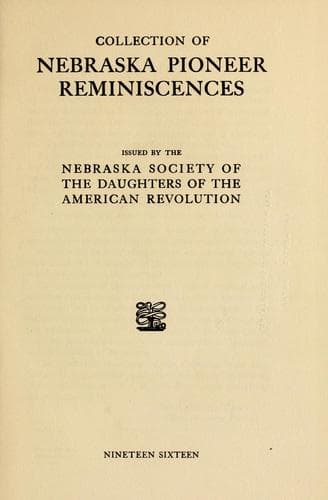
Collection of Nebraska Pioneer ReminiscencesDaughters of the American Revolution. Nebraska
History
Collection of Nebraska Pioneer Reminiscences
Daughters of the American Revolution. Nebraska
Frontier and pioneer life -- Nebraska; Nebraska -- History
"The memories that live and bloom in trees, that whisper of the
loved and lost in summer leaves, are as imperishable as the seasons
of the year--immortal as the love of a mother."--J. STERLING
MORTON.
I suppose the story of a successful pioneer will always interest and
encourage people. The narrative of a strong, far-sighted man who makes
something out of nothing seems to put heart into the average worker.
That is why I am telling the story of how my father, J. Sterling Morton,
and his young wife, set their faces toward the West, one October day in
1854, and built them a home on the prairies.
Arbor Lodge as it stands today, with its classic porticoes, its gardens,
and its arboretum, the present country home of my brother, Mr. Joy
Morton, is not the home that I remember as a boy. That was a much more
modest edifice. Yet even that house was a palace compared with the first
one, which was a little log-cabin standing on the lonely prairie,
exposed to blizzards and Indians, and with scarcely a tree in sight.
My father was a young newspaper man in Detroit, only recently out of
college, when he took his bride, two years his junior, out to the
little-known frontier. Attracted by the information about the new
country brought out by Douglas and others in the Kansas-Nebraska debates
in congress, he conceived and acted on the idea that here were fortunes
to be made. Taking such household goods as they could, they traveled to
the new land, making the last stage up the Missouri river by boat.
Nebraska at that time was the Indian's own country. There were not over
1,500 white people in the entire state. All the country west of the
Missouri was called in the geographies the Great American Desert, and it
took a good deal of faith to believe that anything could be made to grow
where annual fires destroyed even the prairie grass and the fringes of
cottonwoods and scrub-oaks along the rivers. Today this section, within
a radius of some two hundred miles, includes perhaps the most fertile
soil in the world and has become a center of industry, agriculture, and
horticulture for the middle west. There was then no political
organization, no laws; men went about fully armed. There were no roads
and no bridges to speak of in the entire state; it was "waste land."
This was part of the land of the Louisiana Purchase, and my father
bought a quarter section (160 acres) from the man who preÎmpted it from
the government. The price paid was $1.25 an acre. Today the estate
comprises about 1,000 acres, and the land is readily saleable at a
hundred times this price.
Public-domain text, read in full here on John Shaqi.
Reviews
Reviews
No reviews yet
Be the first to share your thoughts on this work.
Elsewhere in the archive
Join the Discussion
Join the discussion
Sign in to leave a comment or review.
Sign InorCreate an account