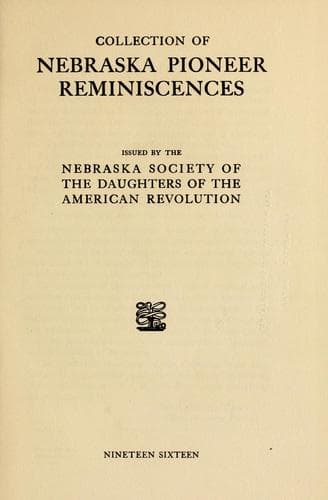
Collection of Nebraska Pioneer ReminiscencesDaughters of the American Revolution. Nebraska
History
Collection of Nebraska Pioneer Reminiscences
Daughters of the American Revolution. Nebraska
Frontier and pioneer life -- Nebraska; Nebraska -- History
It is almost impossible for people of the present day to realize the
hardships and privations that the first settlers in Nebraska underwent.
Imagine coming to a place where there was nothing but what you had
brought with you in wagons. Add to the discomfort of being without
things which in your former home had seemed necessities, the pests which
abound in a new country: the rattlesnake, the coyote, the skunk, the
weasel, and last--but not least--the flea.
My father, Samuel C. Smith, held the post of "trader" for the Pawnee
Indians under Major Wheeler in 1865-66. We lived in a house provided by
the government, near the Indian school at Genoa, or "The Reservation,"
as it was commonly called. I was only a few weeks old, and in order to
keep me away from the fleas, a torture to everyone, they kept me in a
shallow basket of Indian weave, suspended from the ceiling by broad
bands of webbing, far enough from the floor and wall to insure safety.
I have heard my mother tell of how the Indians would walk right into the
house without knocking, or press their faces against a window and peer
in. They were usually respectful; they simply knew no better. Sometimes
in cold weather three or four big men would walk into the kitchen and
insist upon staying by the fire, and mother would have hard work to
drive them out.
The next year my father moved his family to a homestead two miles east
of Genoa where he had built a large log house and stables surrounded by
a high tight fence, which was built for protection against the
unfriendly Indians who frequently came to make war on the Pawnees. The
government at times kept a company of soldiers stationed just north of
us, and when there would be an "Indian scare," the officers' wives as
well as our few neighbors would come to our place for safety. Major
Noyes was at one time stationed there. Firearms of all sorts were
always kept handy, and my mother could use them as skilfully as my
father.
One night my father's barn was robbed of eight horses by the Sioux and
the same band took ten head from Mr. Gerrard, who lived four miles east
of us. E. A. Gerrard, Luther North, and my father followed their trail
to the Missouri river opposite Yankton, South Dakota, and did not see a
white man while they were gone. They did not recover the horses, but
twenty years after the government paid the original cost of the horses
without interest. The loss of these horses and the accidental death of a
brother of mine so discouraged my father that he moved to Columbus in
1870.
One of the delights of my childhood were the nights in early autumn when
all the neighborhood would go out to burn the grass from the prairie
north of us for protection against "prairie fires," as great a foe as
was the unfriendly Indian of a few years before.
Public-domain text, read in full here on John Shaqi.
Reviews
Reviews
No reviews yet
Be the first to share your thoughts on this work.
Elsewhere in the archive
Join the Discussion
Join the discussion
Sign in to leave a comment or review.
Sign InorCreate an account