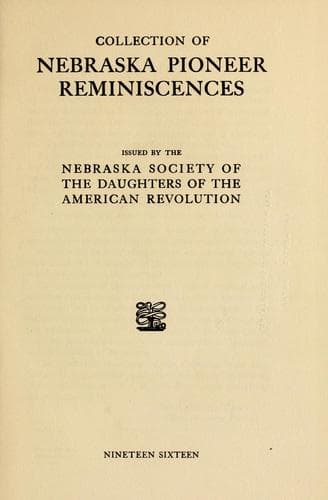
Collection of Nebraska Pioneer ReminiscencesDaughters of the American Revolution. Nebraska
History
Collection of Nebraska Pioneer Reminiscences
Daughters of the American Revolution. Nebraska
Frontier and pioneer life -- Nebraska; Nebraska -- History
"My recollections of early Seward county life do not go back as far as
the author's. They begin with one wind-blown day in September, 1869,
when I, a small urchin from Minnesota, crossed the Seward county line
near Pleasant Dale on my way with my mother and step-father (R. J.
McCall), to the new home on the southeast quarter of section 18, town 9,
range 2 east--about three miles southeast of the present Beaver
Crossing. Looked back upon now, through all the intervening years, it
seems to me there never was an autumn more supremely joyous, a prairie
more entrancing, a woodland belt more alluring, a life more captivating
than that which welcomed the new boy to the frontier in the beautiful
West Blue valley. The upland 'divides' as I remember them were entirely
destitute of settlement, and even along the streams, stretches of two,
three, and five miles lay between nearest neighbors.
"What has become of the Nebraska wind of those days? I have sought it
since far and wide in the Sand Hills and on the table lands of western
Nebraska--that wind which blew ceaselessly, month after month, never
pausing but to pucker its lips for a stronger blast! Where are the seas
of rosin-weed, with their yellow summer parasols, which covered the
prairie in those days? I have sought them too, and along gravelly ridges
or some old ditch yet found a few degenerate descendants of the old-time
host.
"Mention of merely a few incidents seeming to hold the drama and poetry
of frontier life at that time: 'Pittsburgh, the city of vision, at the
junction of Walnut creek and the West Blue, inhabited by a population of
20,000 people, with a glass factory, a paper factory, a brick factory,
oil wells, a peat factory, woolen mills, junction of three railway
lines, metropolis of the Blue Valley.' All this and so much more that I
dare not attempt to picture it; a real existence in the brain of
Christopher Lezenby in the years of 1871-72. What unwritten dramas sleep
almost forgotten in the memories of early settlers! When Mr. Lezenby
began to build his metropolis with the assistance of Attorney Boyd of
Lincoln and a few other disinterested speculators, he was the possessor
of several hundred acres of land, some hundreds of cattle, and other
hundreds of hogs, and a fair, unmarried daughter. What pathetic
memories of the old man, month after month, surveying off his beautiful
farm into city lots for the new metropolis, while his cattle disappeared
from the prairies and his swine from the oak thickets along the Walnut;
with sublime and childish simplicity repeating day after day the
confession of his faith that 'next week' work would begin; 'next week'
the foundation for the factories would be laid; 'next week' the railway
surveyors would set the grade stakes. And this real rural tragedy lasted
through several years, ending in the loss of all his property, the
marriage of his daughter to Irwin Stall, and the wandering forth of the
old man until he died of a broken heart in California.
Public-domain text, read in full here on John Shaqi.
Reviews
Reviews
No reviews yet
Be the first to share your thoughts on this work.
Elsewhere in the archive
Join the Discussion
Join the discussion
Sign in to leave a comment or review.
Sign InorCreate an account