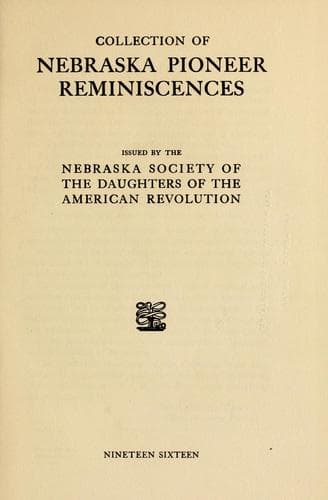
Collection of Nebraska Pioneer ReminiscencesDaughters of the American Revolution. Nebraska
History
Collection of Nebraska Pioneer Reminiscences
Daughters of the American Revolution. Nebraska
Frontier and pioneer life -- Nebraska; Nebraska -- History
The colonists then built houses of cottonwood timber, and a store and
hotel were started. Thus the little town of about two hundred
inhabitants was started with great hopes of soon becoming a large city.
Land on the edge of the bluff had been set aside for a college building.
This was called Collegeview. Here a building was begun in 1856 and
completed in 1859. This was the first advanced educational institution
to be chartered west of the Missouri river.
In 1865 this building was burned. Another building was immediately
erected, but after a few years' struggle for patronage, they found it
was doomed to die, so negotiated with the people of Crete, Nebraska, and
the Congregational organizations (for it was built by the
Congregationalists) in Nebraska. It therefore became the nucleus of what
is now Doane College.
The bell of the old building is still in use in the little village.
The first religious services were held by the Congregationalists. The
church was first organized by Rev. Reuben Gaylord, who also organized
the First Congregational church in Omaha.
In Fontenelle the Congregationalists did not have a building but
worshiped in the college. This church has long since ceased to exist,
but strange as it may seem after so many years, the last regular pastor
was the same man, Rev. Reuben Gaylord, who organized it.
There was a little band of fifteen Methodists; this was called the
Fontenelle Mission. In 1857 an evangelist, Jerome Spillman, was sent to
take charge of this little mission. He soon had a membership of about
three score people. A church was organized and a building and parsonage
completed. This prospered with the town, but as the village began to
lose ground the church was doomed to die. The building stood vacant for
a number of years but was finally moved to Arlington.
The settlers found the first winter of 1855-56 mild and agreeable. They
thought that this was a sample of the regular winter climate; so when
the cold, blizzardy, deep-snow winter of 1856-57 came it found the
majority ill prepared. Many were living in log cabins which had been
built only for temporary use. The roofs were full of holes and just the
dirt for floors.
On awaking in the morning after the first blizzard many found their
homes drifted full of snow; even the beds were covered. The snow lay
four or five feet deep on the level and the temperature was far below
zero.
Most of the settlers lost all of their stock. Food was scarce, but wild
game was plentiful. Mr. Sam Francis would take his horse and gun and
hunt along the river. The settlers say he might be seen many times that
winter coming into the village with two deer tied to his horse's tail
trailing in the snow. By this means, he saved many of the colonists from
starvation.
Public-domain text, read in full here on John Shaqi.
Reviews
Reviews
No reviews yet
Be the first to share your thoughts on this work.
Elsewhere in the archive
Join the Discussion
Join the discussion
Sign in to leave a comment or review.
Sign InorCreate an account