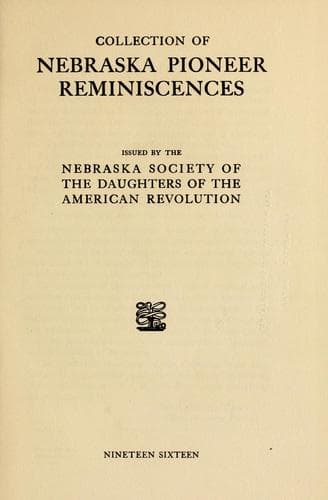
Collection of Nebraska Pioneer ReminiscencesDaughters of the American Revolution. Nebraska
History
Collection of Nebraska Pioneer Reminiscences
Daughters of the American Revolution. Nebraska
Frontier and pioneer life -- Nebraska; Nebraska -- History
He took a claim and worked hard for a few years. He then went back to
Quincy and persuaded a number of his own countrymen to come out to this
new place and take claims, he helping them out, but they were to pay him
back as they could.
Years passed; they each and all became very prosperous. But this first
pioneer prospered perhaps to the greatest degree. The early settlers
moved away one by one; as they left he would buy their homes.
The houses were torn down or moved away, the trees and shrubs were
uprooted, until now this one man, or his heirs--for he has gone to his
reward--owns almost the whole of the once prosperous little village, and
vast fields of grain have taken the place of the homes and streets.
It is hard to stand in the streets of the little village which now has
about one hundred fifty inhabitants and believe that at one time it was
the county-seat of Dodge county, and that it lacked only one vote of
becoming the capital of the state. There are left only two or three of
the first buildings. A short distance south of this village on a high
bluff overlooking the river valley, and covered with oaks and
evergreens, these early pioneers started a city which has grown for many
years, and which will continue to grow for years to come. In this city
of the dead we find many of the people who did much for the little
village which failed, but who have taken up their abode in this
beautiful spot, there to remain until the end of time.
This story of Fontenelle has been gathered from my early recollections
of the place and what I have learned through grandparents, parents, and
other relatives and friends.
My mother was raised in Fontenelle, coming there with her parents in
1856. She received her education in that first college.
My father was the son of one of the first Congregational missionaries to
be sent there. I received my first schooling in the little village
school.
[Illustration: MRS. WARREN PERRY
Eleventh State Regent, Nebraska Society, Daughters of the American
Revolution. 1913-1914]
THOMAS WILKINSON AND FAMILY
Mr. and Mrs. Thomas Wilkinson, early Nebraska settlers, were of English
birth, and came to America when very young. They met in Illinois and
were married in 1859 at Barrington. They moved to Louisiana, remaining
there until the outbreak of the civil war, when they returned to
Illinois for a short time, and then emigrated to the West, traveling in
a covered wagon and crossing the Missouri river on the ferry. They
passed through Omaha, and arrived at Elk City, Nebraska, July 27, 1864,
with their two children, Ida and Emma, who at the present time are
married and live in Omaha.
Soon after arriving in Elk City, Mr. Wilkinson lost one of his horses,
which at that time was a great misfortune. He purchased another from the
United States government, which they called "Sam" and which remained in
the family for many years.
At one time provisions were so high Mr. Wilkinson traded his watch for a
bushel of potatoes.
Public-domain text, read in full here on John Shaqi.
Reviews
Reviews
No reviews yet
Be the first to share your thoughts on this work.
Elsewhere in the archive
Join the Discussion
Join the discussion
Sign in to leave a comment or review.
Sign InorCreate an account