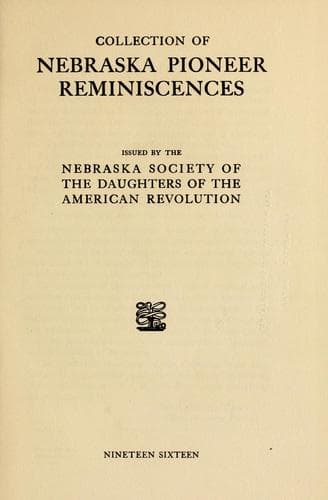
Collection of Nebraska Pioneer ReminiscencesDaughters of the American Revolution. Nebraska
History
Collection of Nebraska Pioneer Reminiscences
Daughters of the American Revolution. Nebraska
Frontier and pioneer life -- Nebraska; Nebraska -- History
The squaw watched him furtively while she drew the deer sinew through
the pieces of skin from which she was fashioning a moccasin. She
understood, although spoken in English, the words he was scarce
conscious of uttering, and, startled out of her Indian instinct of
assumed inattention, looked at him with wide-opened eyes, trying to
fathom a matter hardly comprehended but of great moment to her.
"Take the child"--where, and for what? Was he going to leave and sail
down the great river to the St. Louis whence came all traders and the
soldiers on the boats? Going away again as he had come to her many
seasons ago? "Take the child," her child and his? Her mouth closed
firmly, her eyes darkened and narrowed, as she stooped suddenly and
lifted the child to her lap; and the Indian mother's cunning and
watchfulness were aroused and pitted against the white father's love of
his child.
Fort Atkinson was the most western post of the line established by
President Monroe in 1819, after the Louisiana Purchase, to maintain the
authority of the United States against Indian turbulence and British
aggression, and had been in existence about four years before our story
opens.
Here had been stationed the Sixth U. S. Infantry, who had wearily
tramped for two months the banks of the Missouri river and dragged their
boats after them, a distance of nearly a thousand miles of river travel
to reach this post in the wilderness. Not a white man then occupied what
is now the state of Iowa, except Julien Dubuque and a score or so of
French traders. Not a road was to be found nor a vehicle to traverse
it. But one or two boats other than keel boats and barges had ever
overcome the swift current of the great Missouri thus far.
The Santa Fe trail, that wound over the hills west of the fort,
connected them with the Mexican Spanish civilization of the Southwest,
and the great rivers with their unsettled land far away on the Atlantic
seaboard.
Seventy-five years ago these soldiers dropped the ropes with which they
had dragged the barges and keel boats and themselves thither, and
picking up spade and shovel, dug foundations, molded and burned brick,
cut down trees, and built barracks for themselves and the three
detachments of artillery who terrified the redmen with the mysterious
shells which dropped down amongst them and burst in such a frightful
manner.
They numbered about twelve hundred men, and the bricks they molded and
the cellars they dug still remain to tell of the Fort Atkinson that was,
beside whose ruins now stands the little village of Fort Calhoun,
sixteen miles north of Omaha on the Missouri river.
Dr. Gale, whom we have thus seen considering a question of great
importance both to himself and to the Indian woman with whom he seems to
have some relation, was the surgeon of the Sixth Infantry, an
Englishman, short, thick-set, and evidently of good birth, although the
marks of his rough life and rather dissolute habits obscured it in some
degree.
Public-domain text, read in full here on John Shaqi.
Reviews
Reviews
No reviews yet
Be the first to share your thoughts on this work.
Elsewhere in the archive
Join the Discussion
Join the discussion
Sign in to leave a comment or review.
Sign InorCreate an account