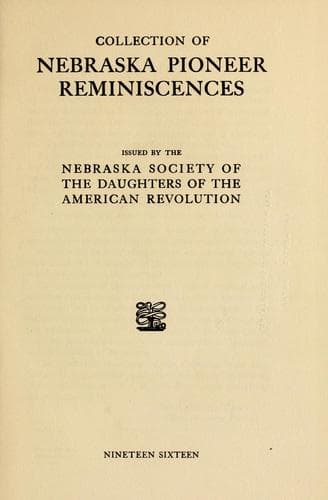
Collection of Nebraska Pioneer ReminiscencesDaughters of the American Revolution. Nebraska
History
Collection of Nebraska Pioneer Reminiscences
Daughters of the American Revolution. Nebraska
Frontier and pioneer life -- Nebraska; Nebraska -- History
In December, 1859, the family crossed the Platte river on the ice and
located on a farm in Cass county, three miles west of the Missouri
river, about three miles southwest of the present town of Murray,
although the old town of Rock Bluffs was their nearest town at that
time. Dr. Wiley and the older children went on ahead with the household
goods and live stock. Mrs. Wiley, with the small children, rode in a
one-horse buggy. She did not know the way and there were no fences or
landmarks to guide her. She had the ague so badly she could hardly drive
the horse. A sack containing $1,800 in gold was tied around her waist.
This was all the money they had, and they intended to use it to build a
house and barn on their new farm. She objected to carrying so much
money, but Dr. Wiley said it was safer from robbers with her than with
him. In spite of her illness and the difficulty in traveling in an
unknown country a distance of thirty-five or forty miles, she reached
the new home safely. She took off the sack of gold, threw it in a
corner, and fell on the bed exhausted. They lived all winter in a log
house of two rooms. There was a floor and roof, but no ceiling, and the
snow drifted in on the beds. Most of the family were sick all winter.
The next summer they built a frame house, the first in that locality,
which caused the neighbors to call them "high toned." Mrs. Wiley bought
a parlor set of walnut furniture, upholstered in green.
General Worth, who had been a congressman, wrote to Washington, D. C.,
and got the commission, signed by Abraham Lincoln, appointing Dr. Wiley
postmaster, the name of the postoffice being Three Groves. They kept the
postoffice eleven years.
They kept the stage station five years. It was the main stop between St.
Joseph and Omaha before the railroad went through. They had from ten to
fifteen people to dinner one coach load. The stage coach was drawn by
four horses, and carried both mail and passengers. The horses were
changed for fresh ones at the Wiley farm. At first the meals were
twenty-five cents; the last two years, fifty cents. This was paid by the
passengers and not included in the stage fare.
Shortly after the discovery of Pike's Peak and gold in Colorado,
freighters, with big freight wagons of provisions drawn by six or eight
oxen, stopped there over night. There were usually twelve men, who slept
on the floor, paying eighteen dollars for supper, breakfast, and
lodging. Mr. McComas and Mr. Majors (father of Col. Thomas J. Majors)
each had freight wagons starting at Nebraska City and taking the
supplies to Denver and Pike's Peak via Fort Kearny, Nebraska. When the
Union Pacific railroad was completed in 1869 the freighters had to sell
their oxen and wagons, as they could not compete with the railroad in
hauling freight.
Public-domain text, read in full here on John Shaqi.
Reviews
Reviews
No reviews yet
Be the first to share your thoughts on this work.
Elsewhere in the archive
Join the Discussion
Join the discussion
Sign in to leave a comment or review.
Sign InorCreate an account