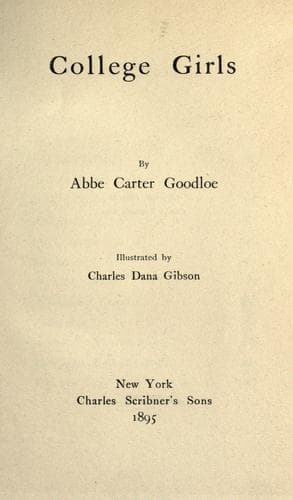
College stories; Women college students -- Fiction
Cunningham grabbed her hand firmly in his. “Now run!” he said. There
were a great many people who stopped to look at the two figures tearing
down Washington Street, and they particularly enlisted the sympathetic
attention of a great many small boys along the way. One policeman,
thinking it was a case of abduction, started after them but gave up the
chase before long, having never gone in much for sprinting, and it being
an unusually warm night in May. It was indeed a rather uncommon sight.
The girl’s clothes and correct air made her particularly noticeable,
while Cunningham in a silk hat, Bond Street coat, and patent leathers,
was a conspicuous object as he swung lightly down the street under the
lamps and electric lights.
When they turned into Kneeland Street, the girl’s courage and strength
failed her. Kneeland Street itself is a disgrace to Boston. It is not by
any means the street a young man would choose to walk on with a young
lady in the evening--indeed it is not the street one would choose to
walk on in broad daylight with a policeman in hailing distance.
Cunningham could have cursed himself for the whole thing. He drew the
girl closer to him and walked swiftly on. When they got in sight of the
station he glanced fearfully at the big clock. It stood at exactly half
after nine, but he comforted himself with the thought that the outside
clock is always fast, though he was not sure just how much.
“Can you run any more?” he asked anxiously of the girl. For answer she
started ahead feverishly.
The man was locking the gate. “Can’t open it--train just pulled out.”
Cunningham looked viciously at the official.
“Can’t you whistle her back?” he demanded, furiously. The man smiled
derisively, and commenced talking to a trainman who sauntered up just
then with an oil-can and hammer in his hand. Cunningham went back to
where Miss Ronald was standing. The girl burst out laughing somewhat
hysterically.
“We need a chaperon badly, Mr. Cunningham,” she said, nervously. “We
don’t seem able to take care of ourselves at all.”
“Yes,” assented Cunningham, gloomily. “It seems easy enough in the
abstract to catch a train, but some way we don’t seem to understand
quite how it’s done,” he added, ironically. “I will go and find out when
the next train leaves, and may be if we are careful and start for it an
hour before time, and if the station doesn’t burn up, or all the cab
horses fall down dead, or the trains stop running, we may be able to
make it.”
Cunningham walked up to the ticket-agent. “When is the next train out?”
he demanded, sternly.
The man glanced up impatiently from a calculation he was making and
said, shortly--“11.10.”
Cunningham strolled back to the girl. “It is obviously impossible to
wait here an hour and forty minutes,” he said. “Suppose we go back to
the theatre and see the last act. We’ve only missed one act at most, and
the last is the prettiest of all.”
Public-domain text, read in full here on John Shaqi.
Reviews
Reviews
No reviews yet
Be the first to share your thoughts on this work.
Elsewhere in the archive
Join the Discussion
Join the discussion
Sign in to leave a comment or review.
Sign InorCreate an account