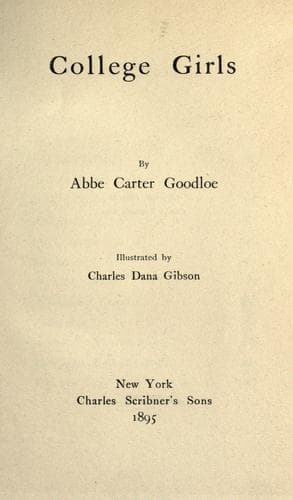
College stories; Women college students -- Fiction
She was thinking hard. Once, when she partially emerged from her
abstraction, she decided with reproach that she could not remember to
have thought so hard for so long a time since leaving college, though in
the meanwhile she had written a tragedy and a small volume of sonnets.
The occasion called for thought. In half an hour he was to be there, and
she had understood from his manner the evening before that she must have
an answer ready for him.
It was all very tiresome. She had warded him off so far, but that could
not go on forever. She had felt a little frightened; he had looked at
her in a way she had never imagined he could look, and she had been
devoutly thankful that just then her “most intimate friend” (even
authors have “intimate friends”) had come in with her brother to make
arrangements about a coaching party for the following Saturday. But she
could not hope for a much longer reprieve. There was a note in his voice
that she could not mistake, as he asked her when he could see her alone.
She wondered now why she had told him at half-past four the next day.
Why had she not said next week, or after she got back from Mexico, or
any other time more remote than the present?
“Yes,” she acknowledged to herself, “I was afraid: and not of him but of
myself. That is the humiliation of it. What was it I read in Ruskin?
That it all ends with Tom, Dick, or Harry? I don’t believe it. At any
rate, I shall not give up my career for any man.”
Miss Hungerford always spoke of her “career” to her friends with a sad
sort of expression, as if it cut her off from them in some unexplainable
way, and made her not of this world. Unconsciously she enjoyed the
mingled admiration and awe of the less ambitiously intellectual of her
“set” when they heard that she was really going to college. When she
came home at vacations they gave her afternoon receptions and
luncheons, because, though of course they never breathed it to her, they
had met with a flat failure when they tried to get their brothers and
masculine friends to come for dinner-dances and “small and earlies.”
“Why, she’s awfully pretty!” they would exclaim when the men pleaded
engagements.
“She’s terribly clever, isn’t she?” they would ask, warily. “Why, of
course, Eva Hungerford is just too bright for anything, but she never
makes one feel it. She doesn’t take a mean delight in showing off one’s
ignorance. She talks just like we do,” they would declare, and the
brothers would smile peculiarly and vanish.
But even her warmest friends admitted that she was carrying things too
far when, at the end of her college career she announced her intention
of taking a course in old English at Oxford, and then of going to France
to study the literature.
Public-domain text, read in full here on John Shaqi.
Reviews
Reviews
No reviews yet
Be the first to share your thoughts on this work.
Elsewhere in the archive
Join the Discussion
Join the discussion
Sign in to leave a comment or review.
Sign InorCreate an account