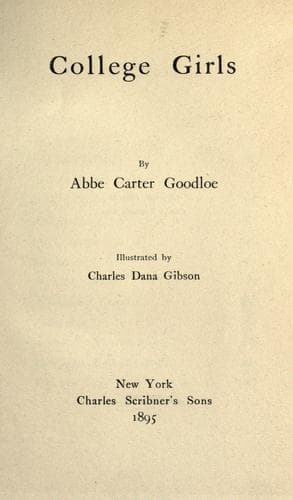
College stories; Women college students -- Fiction
She was not entirely unconscious of the effect she produced, and was
therefore decidedly surprised one day to receive a call from a freshman
who lived only a few doors from her, but of whose existence she had not
been aware. She thought the child--she was very young, not more than
sixteen--uninteresting, and that it was an evidence of extremely bad
taste, and unconventionality on her part to call in that unprovoked way.
But she was very polite to her uninvited guest, and asked her the usual
questions, and the girl, who was very naïve, replied with a loquacity
quite trying to her hostess.
Miss Hungerford was rather indignant after her visitor had gone, and
wondered why she had had to be interrupted in an analytical study of
“Prometheus Unbound,” to listen to a child tell her that she had never
been out of Iowa before, and that her mother had not wanted her to come
to college, but that her father had always said she should have “a
higher education,” and so, after presumably much domestic wrangling, she
was there. Miss Hungerford could not remember much else of what the
young girl had told her, having listened rather absently to her replies,
but she had a distinct impression that her visitor was not at all
good-looking, with only a fine pair of eyes to redeem her pale face, and
that her clothes were atrocious, and that she was
[Illustration: A RATHER CHILLING INFLUENCE]
_gauche_ and decidedly of a social class that Miss Hungerford was not in
the habit of mingling with away from college. For even in a very
democratic college there are social grades, and although it is the thing
to meet in a most friendly way at all class functions, still, a narrow
line of distinction may be perceived on social occasions.
Altogether Miss Hungerford felt rather aggrieved and hoped she would not
be bothered again. But she was. Miss Betty Harmon, of Sioux City, Ia.,
had had a fearful struggle with her timidity and retiring nature, when
she called on Miss Hungerford, and having gained a victory over herself,
she had no intention of resigning the benefits. So she would smile first
when they met in the corridors, and was not above showing how much she
appreciated a few words from Miss Hungerford in praise of her tennis
serve, and that young woman was even uncomfortably conscious that her
youthful admirer had more than once followed her to the library, where,
under pretence of reading, she had stolen furtive glances at her. Later
there were notes, and roses, and requests to go boating.
Miss Hungerford strongly objected to such proceedings, not only because
she did not wish to be rendered ridiculous by an insignificant freshman
from Iowa, but also because she was a very sensible girl, and entirely
disapproved of the “eclectic affinity” business, and she had no
intention of allowing the young girl’s admiration for herself to develop
into that abnormal sort of attraction that exists between girls in so
many schools and colleges.
Public-domain text, read in full here on John Shaqi.
Reviews
Reviews
No reviews yet
Be the first to share your thoughts on this work.
Elsewhere in the archive
Join the Discussion
Join the discussion
Sign in to leave a comment or review.
Sign InorCreate an account