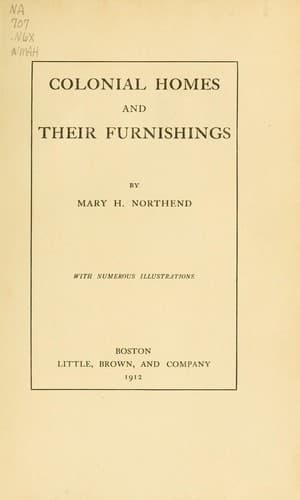
Colonial Homes and Their FurnishingsNorthend, Mary Harrod
History
Colonial Homes and Their Furnishings
Northend, Mary Harrod
Architecture, Colonial; Furniture -- United States
Perhaps the rarest bit of pewter in existence to-day is that owned by a
Massachusetts lady. It is of Japanese manufacture, and is a family
heirloom, through generations back. It first came into possession of the
owner's ancestors in 1450; even at that date it had a history, and,
indeed, its battered sides speak eloquently and forcibly of a past. It
is said to have been the possession of a French nobleman, who, for some
cause or other, was compelled to flee from his native land, and who
sought refuge in England, where he met and married an English girl. The
precious bit remained with his descendants until the year above
mentioned, when the last of his race, dying without issue, bequeathed
the old relic to his dearest friend, of whom its present owner is a
direct descendant.
But whatever its type and origin, the old ware is always interesting. To
be sure, even at its best it is plain, relying on its form for its
pleasing appearance, but no other metal better repays its owner for the
care expended upon it. No doubt it costs an effort or two to keep it
bright and shining, but who does not feel repaid for the time and energy
expended, when the slow gleams of silver-like hue that gradually appear
on the surface greet one in appreciation, like the smile of an old
friend!
CHAPTER XVII
OLD SILVER
There is a widespread and growing interest in all old silver, especially
in such pieces as can be traced back to colonial origin. Salem, whose
commercial prosperity was well established by the middle of the
seventeenth century, has some wonderfully good pieces of colonial
silver, many of which are family heirlooms.
The early American silverware, like our early furniture and
architecture, is thoroughly characteristic of the tastes and mode of
life peculiar to that period in America. It is simple in design and
substantial in weight, thus reflecting the mental attitude of the
people. Social conditions here would not warrant any imitation of the
magnificent baronial silver which was then being made and used in
England. Many of the pieces in these collections come to us hallowed by
a hundred associations and by traditions recalling the lives of our
forefathers in all their manifold phases. The sight of the silver
communion service recalls the early history of our New England
churches, and reminds us of the devotion of the people to the
institutions about which revolved both the social and political life.
Only the identity of the maker is revealed by the hallmark on American
silver. There is no trace of the date letter, so prevalent upon English
pieces of the same period, although various emblems appear, which were
used as trademarks, peculiar to the owner. In cases where the crown
appears above the initials, it was merely a passing fad to copy the mark
of certain English silversmiths who enjoyed royal patronage.
Public-domain text, read in full here on John Shaqi.
Reviews
Reviews
No reviews yet
Be the first to share your thoughts on this work.
Elsewhere in the archive
Join the Discussion
Join the discussion
Sign in to leave a comment or review.
Sign InorCreate an account