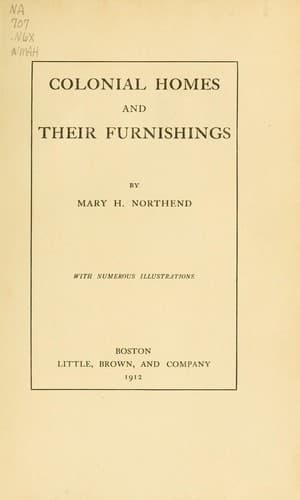
Colonial Homes and Their FurnishingsNorthend, Mary Harrod
History
Colonial Homes and Their Furnishings
Northend, Mary Harrod
Architecture, Colonial; Furniture -- United States
Other specimens still preserved include a tall sugar bowl, mounted upon
a standard, which is more than a hundred years old, as are the tongs
used with it, with their delicate acorn-cup pattern. In the larger
piece, the rings which form the handles pass through the mouth of a
dog's head, upon each side. The feet which support the standard suggest
the work done in the furniture of that day by Chippendale, Sheraton, and
their followers. To the latter days of the eighteenth century belong an
endless yet interesting variety of patterns of porringers, salvers,
sugar bowls, perforated baskets for loaf sugar, tea and coffee pots, and
innumerable table utensils.
Another article which is now found but rarely is the nutmeg holder or
spice box. The interior of the lid was roughed for use as a grater, and
few were the "night caps" but had a final touch added through its use.
While the usefulness of the spice box and the snuffbox has long since
passed away, yet they are treasured because of the pictures they bring
to the mind's eye of the old days of the Georges. No product of the
present can outvie the charms of such old silver.
All things colonial, whether house or accessory, are distinctive, and to
the designers and craftsmen of that period the world owes a debt that no
amount of tribute can ever wholly repay. Colonial is synonymous of the
best, and objects created during its influence are always of a higher
degree of perfection than the best of other periods. Looking about for a
reason for this, we are confronted with the realization that the work
of that time was carefully planned and carefully finished, craftsmen
giving to their output the best their brains could devise, and allowing
no reason, however urgent, to interfere with the completion of a certain
object as they had originally planned it to be. Therein lies the real
reason of the superiority of things colonial. Later-day artisans
sacrificed quality to quantity; they complied with the demand of public
opinion, and as that demand became more urgent, carelessness of detail
became more marked. The simplicity of the colonial era gave way to the
highly decorative and often ugly ornamentation characteristic of late
nineteenth-century manufacture, and it was not until a few craftsmen
found courage to revive colonial features that the beauty of that type
of construction was truly appreciated. To-day, colonial influence is
again dominant, and it is a relief to note that in modern homes it is
usurping in favor its hitherto prized successors. It is only to be hoped
that its influence will be lasting, for surely of all types it is the
most worthy of emulation.
INDEX
Public-domain text, read in full here on John Shaqi.
Reviews
Reviews
No reviews yet
Be the first to share your thoughts on this work.
Elsewhere in the archive
Join the Discussion
Join the discussion
Sign in to leave a comment or review.
Sign InorCreate an account