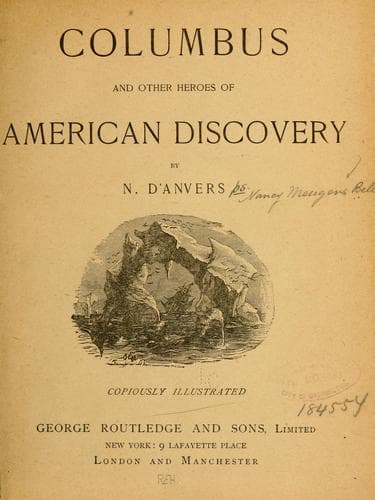
Columbus and Other Heroes of American DiscoveryD'Anvers, N.
History
Columbus and Other Heroes of American Discovery
D'Anvers, N.
America -- Discovery and exploration; North America -- Discovery and exploration
While Dreuillette was laboring in the North, René Mesnard, who had
been one of the missionaries to the Iroquois, excited by the accounts
given by two fur-traders, who had spent a winter on the banks of
Lake Superior, started to found a church among the fierce Sioux, or
Dacotahs, dwelling in those remote districts. He reached the southern
shores of Lake Superior in the autumn of 1660, and in the spring
of the following year began his journey toward the modern state of
Minnesota, which lies between the south-western extremity of the great
lake and the Dakota territory. Letters describing his progress were
occasionally received at Quebec, but they suddenly ceased; and after
much anxiety on his account, rumors were brought in by traders that
he had become separated from his companions, and lost his way in the
forests on the south of the Bay of Chagwamegan, and must have perished
miserably. The event proved that they were right. Mesnard’s body was
found in the forest by a native, who long concealed the fact, lest
he should be accused of the murder of the white man. The cassock and
breviary of Mesnard having, however, been preserved as amulets by the
Sioux, led to inquiries being made, and the truth was discovered.
In 1665, a fresh impulse was given to missionary effort in Canada by
the transference of the country to a new West Indian Company, under
the direct patronage of Louis XIV., who, recognizing the importance
of the rich fur-yielding districts of New France, sent out a regiment
to protect the traders. True, about this time New Netherland was
conquered by the English, who thus became very formidable rivals to
the French; but the Iroquois still separated the two European nations,
and yet a little longer the evil day of the loss of Canada was
deferred.
The first hero to go forth under the new government was Father Allouez,
who, following in the footsteps of Mesnard, arrived on the banks of
Lake Superior early in September, 1666. Embarking on its waters in
a native canoe, he reached the village of Chagwamegan, on the bay
of the same name, where members of no less than ten different native
races were assembled, discussing how best to prevent a threatened war
between the Sioux and the Chippewas.
Public-domain text, read in full here on John Shaqi.
Reviews
Reviews
No reviews yet
Be the first to share your thoughts on this work.
Elsewhere in the archive
Join the Discussion
Join the discussion
Sign in to leave a comment or review.
Sign InorCreate an account