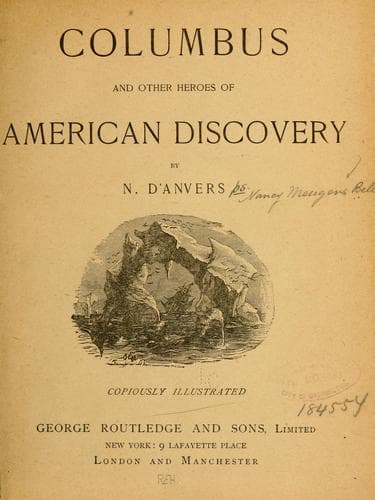
Columbus and Other Heroes of American DiscoveryD'Anvers, N.
History
Columbus and Other Heroes of American Discovery
D'Anvers, N.
America -- Discovery and exploration; North America -- Discovery and exploration
A good understanding having been thus established between the natives
and their guests, the white men were allowed to proceed up the river.
Some little distance from its mouth, the explorers met an Indian who
knew the language of some of the native escort, and by this means
intelligible communications were opened with the people. As their
brethren had done in the South, the Spaniards gave out that they were
the Children of the Sun, sent by the life-giving Deity to rule over
the natives of Arizona. Asked how it was they had so long delayed
their coming, and, having come, could not speak the language of their
subjects, they replied in an evasive yet reassuring manner. In due
course a second Indian joined the party, who not only knew all about
Cibola, but had even heard of Da Nizza’s expedition. From him Alarchon
learned that he was but ten days’ journey from the great city, and
he tried to persuade some of his companions to cross the country and
communicate with Coronado, who must by this time have been within
easy reach. No one could, however, be induced to make the venture, and
Alarchon――somewhat rashly, as it seems to us――resolved to turn back.
Sailing down the river, he returned to Mexico, having accomplished
next to nothing.
Meanwhile, Coronado had bravely led his troops over the rugged
mountainous districts of the north of Mexico, and in spite of much
murmuring on their part on account of the hardships endured by the way,
he had brought them safely to the plain of the Seven Cities. Here, on
the very eve of success, he was met by a large force of armed Cibolans,
who rejected all his efforts at conciliation. In the battle which
ensued, the Spaniards were finally victorious, and the city of Cibola
was taken; but Coronado was dangerously wounded in the assault, and
the long hoped-for plunder was nowhere to be found. Cibola was but a
large village, situated on a lofty and bleak plain, yielding plenty
of grass, maize, and pebbles of rock crystal, but no gold, silver, or
precious stones.
As soon as he could travel, Coronado, disguising his disappointment as
best he could, took possession of Cibola in the name of his Catholic
Majesty of Spain, and collected information on all sides as to the
nature of the country beyond the plain of the cities. Learning that a
great town called Quivira existed somewhere on the coast, he led his
men to a distance of about 300 leagues through a level and somewhat
barren country, finally arriving at the town in question, which turned
out to be really large and wealthy, though its riches consisted in
a fine breed of cattle, not in the precious metals and minerals for
which the Spaniards had hoped.
Feeling that he had now accomplished something, Coronado then led
his forces back to Mexico. As usual, very exaggerated reports were
circulated by his followers as to what they had seen and done; and
though its site has never yet been ascertained, Quivira was the goal
of many a future expedition.
Public-domain text, read in full here on John Shaqi.
Reviews
Reviews
No reviews yet
Be the first to share your thoughts on this work.
Elsewhere in the archive
Join the Discussion
Join the discussion
Sign in to leave a comment or review.
Sign InorCreate an account