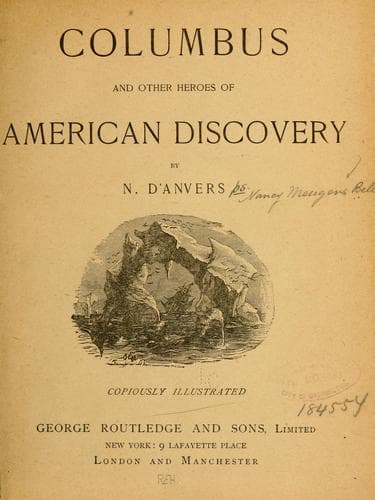
Columbus and Other Heroes of American DiscoveryD'Anvers, N.
History
Columbus and Other Heroes of American Discovery
D'Anvers, N.
America -- Discovery and exploration; North America -- Discovery and exploration
While the Pequod war was still in progress, a fresh colony arrived at
Boston from England, including John Davenport and Theophilus Eaton,
men of wealth and social station, whom the Massachusetts authorities
would gladly have retained among them. There were, however, now no
good lands to spare for new-comers near the old settlements, and it
was absolutely necessary for them to seek some other home. At the
close of the war, therefore, Eaton and Davenport led their little band
into Connecticut, where a tract of land, south of the settlement of
Saybrook, had been already purchased for them of the native chief for
“twelve coats of English cloth, twelve alchemy spoons, twelve hatchets,
twelve hoes, two dozen knives, twelve porringers, and four cases of
French knives and scissors.”
Originally called Quinniack, or Quinnepaca, the new settlement shortly
received the name of New Haven, and grew with a rapidity hitherto
unknown in colonial annals. From among its wealthy members, one after
another went forth to found new towns in its neighborhood, until, in a
very short time, Connecticut was colonized all along the shore and far
inland. This great movement was further supplemented by the constant
arrival of new recruits, alike from the mother country and the elder
colonies of Massachusetts, and we soon find the English pushing their
outposts as far south as the Hudson, gradually displacing the Dutch,
and again driving the Indians to desperation. In 1643, the settlements
in Massachusetts, New Hampshire and Connecticut formed that league,
under the title of the United Colonies of New England, for mutual
protection against the Dutch, French and Indians, which may be looked
upon as the opening of the first chapter of the political history
of the United States; but for the continuation of that history we
must refer our readers to the many volumes on the subject already
in existence. Our task being to trace the gradual opening up of
new districts, we must leave the infant federation to fight out its
battles, alike with its European neighbors, the schismatics within
its own borders, and the true owners of the disputed territories,
unwatched by us. We return once more to the South, to find the
districts between Virginia and Florida occupied under the name of
Carolina, so-called in honor of Charles IX. of France, by a few
non-conformists from England and Virginia, who had gathered about the
promontory aptly named Cape Fear (N. lat. 33° 48′) where they hoped
to work out their own salvation, free from the temptation of the world
they had renounced. Their expectations were, as a matter of course,
disappointed. After the English Restoration, Charles II. re-asserted
his claim to that part of America long known under the general name
of South Virginia, and granted the fertile districts between Albemarle
Sound (N. lat. 35° 59′), and the river St. John (N. lat. 30° 23′), to
eight of his favorite noblemen, the terms of concession making them
Public-domain text, read in full here on John Shaqi.
Reviews
Reviews
No reviews yet
Be the first to share your thoughts on this work.
Elsewhere in the archive
Join the Discussion
Join the discussion
Sign in to leave a comment or review.
Sign InorCreate an account