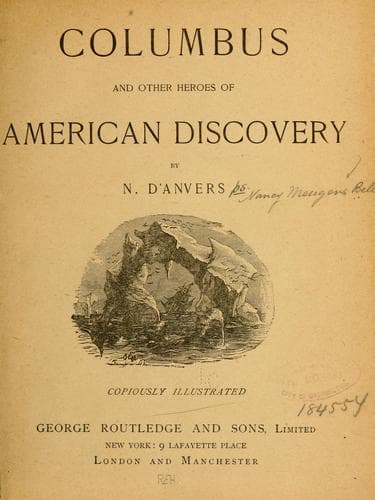
Columbus and Other Heroes of American DiscoveryD'Anvers, N.
History
Columbus and Other Heroes of American Discovery
D'Anvers, N.
America -- Discovery and exploration; North America -- Discovery and exploration
In March, 1771, we find the energetic explorers again on the Kentucky
River, where they resolved to form a settlement, and whence they
started in the ensuing month for the Yadkin of North Carolina to
bring out their families. Two years elapsed before the necessary
arrangements could be made, and meanwhile rumors reached the Eastern
States of explorations made by other parties, who, without any
preconcerted plans, were simultaneously wandering about on the banks
of the Cumberland and Tennessee Rivers. In June, 1769, but one month
after the first entry into Kentucky of Boone, some twenty men, from
North Carolina and West Virginia, made their way over the Alleghanies,
and through the Cumberland mountain pass to the river of the same name,
into the south-west of Kentucky, the whole of which they thoroughly
scoured, returning home in April, 1770, laden with the results of
their hunting excursions.
In the same year, 1769, a second company of hunters built a boat and
two trapping canoes, and in them paddled down the Cumberland River
to the Ohio, and again down the Ohio to the Mississippi, embarking
on which they made their way to Natchez, where they sold their furs
to great advantage. This was of more importance to them than the fact
that this trip of theirs connected the work of the English from the
East with that of the French from the South, which alone entitles them
to a place in our narrative.
In 1771, the Cumberland was again navigated, this time from the north,
by Casper Mansso and some half a dozen companions, who penetrated into
the so-called barrens of the south of Kentucky, where they met other
hunters from the East. Thus, by the time of Boone’s return in 1773,
Kentucky, though still unsettled by any white man, was no longer the
unknown district it had been on his first visit, and he appeared to
have many rivals in the field.
The little caravan of settlers, which included Boone’s own family
and that of five others, started on its arduous journey across the
Alleghanies in September, 1773, and in the now well-known Powell’s
Valley its numbers were augmented by forty well-armed men, who had
determined to throw in their lot with the emigrants. The transit
of Powell’s Gap or Pass was succeeded by that of Wallen’s Ridge,
and the augmented party were entering the last of the triple range
of mountains by the way of Cumberland Gap, when they were suddenly
attacked by Indians. Six white men, including Boone’s eldest son James,
were killed, and the cattle were dispersed, before the Indians were
driven back. This tragedy so disheartened the emigrants that they
declined to go further; and though Boone, in spite of his intense
grief at the loss of his boy, would have persevered, he was obliged
to yield to the numbers against him.
Public-domain text, read in full here on John Shaqi.
Reviews
Reviews
No reviews yet
Be the first to share your thoughts on this work.
Elsewhere in the archive
Join the Discussion
Join the discussion
Sign in to leave a comment or review.
Sign InorCreate an account