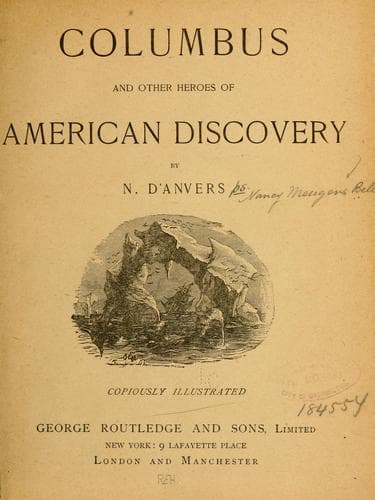
Columbus and Other Heroes of American DiscoveryD'Anvers, N.
History
Columbus and Other Heroes of American Discovery
D'Anvers, N.
America -- Discovery and exploration; North America -- Discovery and exploration
THUS far our heroes have, with few exceptions, been pioneers rather
of Christianity, emigration or commerce, than of discovery properly so
called. Early colonization in America was not, as in Africa, preceded
by scientific exploration. We have no trans-Atlantic Park or Bruce, no
Lander Oudney, or Clapperton; the white martyrs who baptized the soil
of the New World with their blood fell, not in the cause of geography,
but in that of their homes or their religion. Only in the extreme
North have we any romance in American travel which can at all compare
with that so inseparably connected with the winning of each of the
secrets of that sister continent so aptly named the Dark.
The great lakes, rivers, and mountains of America, which we will in
our turn call the “Fair Continent,” were rather found than discovered.
The emigrant, seeking water for his cattle, or timber for his log
hut and his fire, pitched his tent by some vast inland sea or rushing
stream, unconscious that he had done more than choose well for his
immediate temporal needs. Other log huts rose beside his own; the
neighboring lake or river or forest received the name of the first
person who turned its resources to account, or retained a corrupted
form of its original Indian denomination. Peculiarities in the manners,
customs, or appearance of the natives, which would have been full of
significance to men such as Park or Bruce, Livingstone or Stanley,
passed unnoticed by the lonely squatter of the woods, and whole
chapters of discovery were left unwritten by the unconscious agents in
the opening up of new tracks.
Not until the beginning of the present century can we be said to have
possessed a literature of inland North American discovery, and our
narrative has hitherto been culled little by little from piles of
volumes dealing with other subjects than ours, and referring _en
passant_ only to geographical problems. The young states forming
the infant republic had too much to do in welding into one whole the
varied and often incongruous elements of which they were themselves
composed, to be able to pay much attention to the enterprising spirits
who went forth from among them to found new homes in the wilderness.
But when the turbulent infancy was over, and what we may call the
young manhood of America began under the enlightened guidance of the
great Washington, first President of the United States, a new era of
discovery was ushered in. The republic, no longer content with its
ignorance of the course of its rivers, the height of its mountains,
and the resources of its vast tracts of prairie and forest lands,
began the organization of exploring expeditions. The first of these
was that sent out, under Major Pike, in 1805, with instructions
“to explore the Upper Mississippi, to inquire into the nature and
extent of the fur-trade, with the residence and population of the
several Indian nations, and to make every effort to conciliate their
friendship.”
Public-domain text, read in full here on John Shaqi.
Reviews
Reviews
No reviews yet
Be the first to share your thoughts on this work.
Elsewhere in the archive
Join the Discussion
Join the discussion
Sign in to leave a comment or review.
Sign InorCreate an account