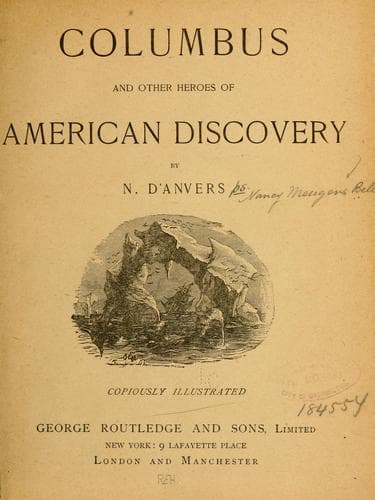
Columbus and Other Heroes of American DiscoveryD'Anvers, N.
History
Columbus and Other Heroes of American Discovery
D'Anvers, N.
America -- Discovery and exploration; North America -- Discovery and exploration
The explorers were now approaching the summit of the central table
land of the North American continent, where, 1,680 feet above the
sea-level, are situated the sources alike of the St. Lawrence, the
Mississippi, and the Red River of the North, the three great arteries,
bound, the first for the Atlantic Ocean, the second for the Gulf of
Mexico, and the third for Hudson’s Bay. As the common home of the
infant streams was neared, the navigation of the Mississippi became
more difficult, the river between the mouth of the Minnesota and the
Falls of St. Anthony consisting of a series of rapids dashing over
huge rocks encumbering the bed of the stream. Pike persevered, however,
in his work of navigation, his little bark experiencing many a narrow
escape in its passage between the frowning precipices, until the Falls
themselves were reached, when he was compelled to leave his own boat
and take to small canoes.
For four miles above the Falls, in the grandeur of which Pike owned
himself a little disappointed, all went well, but the remainder of the
trip was fraught with difficulties and dangers of every description.
Again and again the travelers were compelled to disembark, and wading
through the water, often not a foot above the rocks, drag their boats
after them, while every now and then some wild Sioux warrior would
appear upon the beetling heights shutting in the now restricted Father
of Waters, and brandish his spear above the heads of the defenseless
whites.
On the 4th October the mouth of the Crow River was passed on the
west, and the first signs of dangers of a new description were noted
in the wrecks, lying here and there of bark canoes, cut to pieces
with tomahawks, and with broken paddles and arrows lying near. Pike’s
interpreter told him that the canoes were of Sioux and the arrows of
Minnesota construction, pointing to the conclusion that war was raging
hotly close at hand. Further examination of the relics revealed marks
on the paddles of the canoes signifying that Indian men and women had
been killed, and the guide was eager in urging retreat, on the ground
that their party would be taken for Sioux invaders, and be cut to
pieces at the first Chippeway village before any explanation could be
given. Only a little time before, three Frenchmen who had ventured up
the river had been murdered by the Chippeways; surely the white man
would not risk sharing their fate?
Public-domain text, read in full here on John Shaqi.
Reviews
Reviews
No reviews yet
Be the first to share your thoughts on this work.
Elsewhere in the archive
Join the Discussion
Join the discussion
Sign in to leave a comment or review.
Sign InorCreate an account