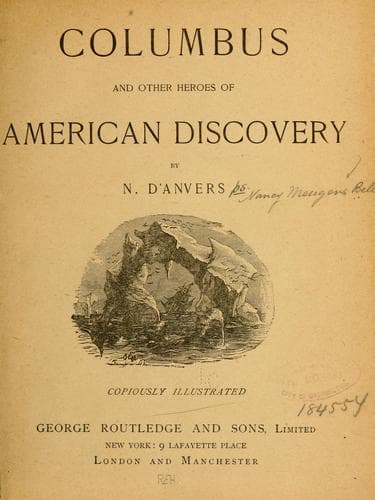
Columbus and Other Heroes of American DiscoveryD'Anvers, N.
History
Columbus and Other Heroes of American Discovery
D'Anvers, N.
America -- Discovery and exploration; North America -- Discovery and exploration
The exploring party, which consisted of twenty-three members,
including a surgeon and an interpreter, started on this second journey
on the 15th July, 1806, taking with them a number of Indians belonging
to the Osage and Pawnee tribes, who had been redeemed from captivity
among the Potawatomies, and were now to be restored to their friends.
Ascending the Missouri in two boats, the mixed company reached, on
the 26th July, the Osage River, which, flowing from the south, pours
its vast bulk of waters into the Missouri. Here they were received
with eager, though quiet enthusiasm by the natives, and a touching
scene ensued between the relatives restored to each other through the
mediation of the white men.
The Osage Indians, dwelling in the fair country on either side of
the beautiful river named after them, seem to have attained to a rare
degree of civilization, possessing a kind of republic, presided over
by a small body of chiefs, whose resolutions required the ratification
of a selected council of warriors. Pike and his white companions were
feasted with grain, beans and pumpkins, the number of entertainments
being rather embarrassing, as it was considered etiquette to taste of
every thing offered.
Leaving the friendly Osage Indians still rejoicing over the return of
the captives, Pike now struck across the country in a south-easterly
direction for the Arkansas River, passing the mouth of the Platte and
Kansas, both minor tributaries of the Missouri, on whose banks dwelt
the Pawnee Indians, a race differing but little, if at all, from the
Osages. After an arduous march through a mountainous country, the
dividing range between the Kansas and Arkansas Rivers was crossed
on the 14th October, and late on the same day a branch of the latter
river was reached.
On Sunday, the 19th October, the Arkansas itself was first sighted,
and, crossing it in canoes, constructed on the spot under his own
superintendence, the gallant young leader proceeded to carry out the
instructions he had received, by tracing its course through all its
devious windings, in what was then an untrodden wilderness, tenanted
chiefly by buffalo, elk, deer, and wild horses.
Being totally unprepared for the great length of the river between
its junction with the Mississippi in north latitude 34° 54′ and
west longitude 91° 10′, or for the severity of the climate, as
its birthplace in the Rocky Mountains on the borders of Utah was
approached in mid-winter, the explorers endured very great hardships.
The head of the Arkansas River was reached late in December, and was
found to be no less than 192 miles west of its outlet from the mighty
ridge dividing the rivers flowing into the Pacific from those which
find their final home in the Arctic Ocean, Hudson’s Bay, or the Gulf
of Mexico.
Public-domain text, read in full here on John Shaqi.
Reviews
Reviews
No reviews yet
Be the first to share your thoughts on this work.
Elsewhere in the archive
Join the Discussion
Join the discussion
Sign in to leave a comment or review.
Sign InorCreate an account