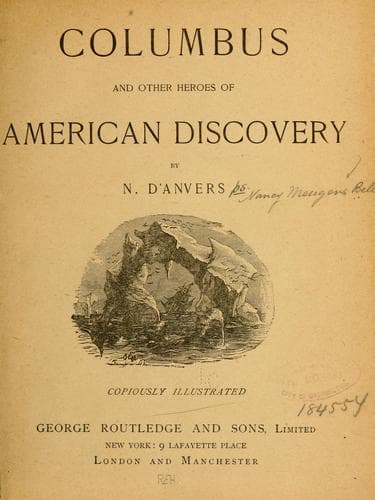
Columbus and Other Heroes of American DiscoveryD'Anvers, N.
History
Columbus and Other Heroes of American Discovery
D'Anvers, N.
America -- Discovery and exploration; North America -- Discovery and exploration
After a detention of some months at Santa Fé, already a fine city,
situated among the Rocky Mountains on a plain 1,047 feet above the
sea-level, the Americans were sent back to their own territory by a
circuitous route through New Mexico and Texas, which, though then as
now tenanted by the wild and predatory Navajoe, Apache, Utah, Comanche,
and other tribes, they found to be traversed by fairly good roads made
for the use of missionaries and miners, who had now for more than two
centuries been at work in these western wilds.
Pike arrived at Natchitoches on the Red River on the 1st July, after
an absence of one year from the United States, and we hear no more of
him as an explorer. The work done by him was, however, but the prelude,
or rather――as much of it was simultaneous with that of the heroes
we are now about to join――the accompaniment of the more extensive
expedition under Captains Lewis and Clarke, sent out by the American
Government in May, 1804, with orders to explore the Missouri, the
chief of all the affluents of the Mississippi, to its source, and then
to make their way by the shortest route to the first navigable water
on the western side, which they were to trace to the shores of the
Pacific.
Illustration: CAPTAIN LEWIS BEHOLDING THE MISSOURI.
The new expedition, consisting of some forty-five members――sixteen
only of whom were, however, to go the whole distance――and provided
with one keel-boat and two open boats, started up the Missouri on the
16th May, 1804. The French outposts of St. Charles and La Charette,
in the present state of Missouri, were passed, the exact positions of
the mouths of the Osage, Kansas, and Platte tributaries were noted,
and the unknown districts occupied by the Ottoe Indians were entered
in July. Here the American explorers held a meeting with a number of
Ottoe chiefs, who expressed themselves pleased that their land now
belonged to the white men from the East instead of the French, and
added the naïve hope that their father, President Jefferson, would
send them arms to defend themselves from their enemies, and hunt game
for themselves and their little ones.
Beyond the mouth of the Platte, or Nebraska, the work of surveying
the Missouri became extremely arduous, on account of its many and
sudden windings. On one side lay the picturesque prairie and forest
lands of Iowa, with its rugged ravines and striking bluffs; on the
other the vast plain of Nebraska, sloping gradually upward to the
Rocky Mountains. Now in Iowa, now in Nebraska, the party steadfastly
followed the course of the fickle river, and toward the close of
August they came to the mouth of the Sioux River, on the borders of
Dacotah, where they found themselves on comparatively familiar ground,
the Dacotah or Sioux warriors having long been on friendly terms,
alike with the Americans from the East and the French from the North.
Public-domain text, read in full here on John Shaqi.
Reviews
Reviews
No reviews yet
Be the first to share your thoughts on this work.
Elsewhere in the archive
Join the Discussion
Join the discussion
Sign in to leave a comment or review.
Sign InorCreate an account