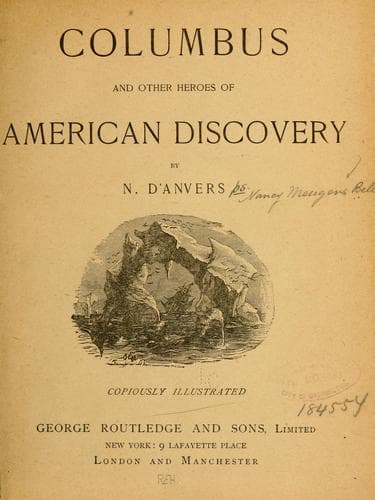
Columbus and Other Heroes of American DiscoveryD'Anvers, N.
History
Columbus and Other Heroes of American Discovery
D'Anvers, N.
America -- Discovery and exploration; North America -- Discovery and exploration
Back again at last at Nootka Sound, fresh difficulties arose. The men,
so loyal at first, showed signs of mutiny, and the chief offenders
were sent on shore, where, falling into the hands of native chiefs,
they endured much hardship, from which they were finally rescued
by Meares, who received them back into his service, after repeated
professions of contrition.
As will be understood, so much time had been lost in the détour to the
south, that little was effected in the way of actual discovery on this
second trip. Forts were, however, erected at several points on the
shores of Nootka Sound, and a cargo of great value was taken back by
Meares to his employers――two facts which paved the way for the fitting
out of an important expedition, consisting of several vessels, under
the great Vancouver, who added more than any of his predecessors to
our scientific knowledge of the north-western shores of America.
De Fuca, Meares, and others of lesser note, had, throughout their
examination of the new districts discovered by them, divided their
attention between trade and geographical exploration. Vancouver
appears to us to have been a man of a different and more intellectual
stamp; and though he can scarcely be said to have been the first
to _see_ the important island named after him, as it can not have
escaped the observation of any mariners anchoring in Nootka Sound,
he undoubtedly revealed the fact of its complete separation from the
mainland, and won recognition for its great natural resources and its
commanding geographical position.
Between the return home of Meares and the starting of Vancouver,
disputes had arisen between the English and Spanish, as to which were
the true owners of the lands from whence came the treasures brought
home by the now numerous traders and whalers who frequented the
Northern Pacific waters. These disputes were finally adjusted by the
acceptance by the Spanish Government of Cape Mendocino (N. lat. 40°
20′) as the most northerly limit of its jurisdiction in the New World.
As a result, Vancouver’s work was limited to the examination of the
coast above that boundary; and with the understanding that he should
not encroach below it, he started from England on his grand voyage on
the 15th December, 1790, arriving off the coast of America, in N. lat.
37° 55′, about the 15th April of the ensuing year.
Public-domain text, read in full here on John Shaqi.
Reviews
Reviews
No reviews yet
Be the first to share your thoughts on this work.
Elsewhere in the archive
Join the Discussion
Join the discussion
Sign in to leave a comment or review.
Sign InorCreate an account