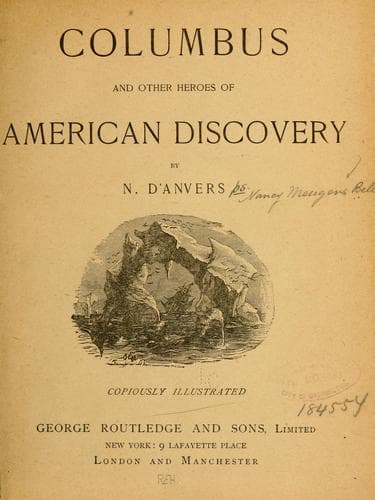
Columbus and Other Heroes of American DiscoveryD'Anvers, N.
History
Columbus and Other Heroes of American Discovery
D'Anvers, N.
America -- Discovery and exploration; North America -- Discovery and exploration
A few years after the return of James to England, a Frenchman named
Grosseliez made a journey of discovery from Canada, and, after a
successful cruise up the western shores of Hudson’s Bay, landed in
Nelson’s River. Here, to his intense astonishment, he found a little
settlement of white men, who had made their way thither from Boston,
and were struggling, in spite of the rigorous climate, scarcity
of food, etc., to gain a permanent footing in the country. Leaving
these unexpected rivals to fight out their battles as best they could,
Grosseliez completed his own survey of the surrounding districts,
and hastened with it to France, hoping to gain the patronage of
the French monarch for an emigration scheme of his own. He entirely
failed in this purpose, but his pertinacity won for him the notice
of Mr. Montague, at that time English ambassador at Paris, who gave
him a letter of recommendation to Prince Rupert, then, after many
vicissitudes, in the very zenith of his prosperity.
Though at this time engaged in the eager prosecution of the
newly-discovered art of mezzotint engraving, which owed so much of its
perfection to him, Prince Rupert at once turned his attention to the
geographical problem laid before him by Grosseliez. The desirability
of securing to England the monopoly of the fur-trade of the North,
with the possibility of winning a new water highway to the North
through the as yet unexplored ice-blocked channels of the Great Bay,
or to the Pacific through some inland passage still to be discovered,
was recognized at once. Prince Rupert obtained the consent of his
cousin, Charles II., to the sending out of a pioneering expedition
under Captains Zachariah Gillam and Grosseliez; and in the summer of
1668, their little vessel entered Hudson’s Straits.
This time the eastern shores of the bay were explored, and a little
river flowing into the south-eastern extremity from Lake Mistassinie
was discovered, to which the name of Rupert was at once given. A fort
was erected at its mouth, and the adventurers returned home with a
report that lands rich in furs stretched away as far as the eye could
reach, on the east as well as on the west of Hudson’s Bay.
Encouraged by the result of this preliminary experiment, Prince
Rupert now obtained from Charles a charter, conferring on himself
and nine associates absolute proprietorship, subordinate sovereignty,
and exclusive traffic in a territory of undefined extent, embracing,
however, all the regions discovered or to be discovered within
Hudson’s Straits, and all lands from which rivers flowed into Hudson’s
Bay, saving only such as were already in the possession of any
Christian State or prince.
Public-domain text, read in full here on John Shaqi.
Reviews
Reviews
No reviews yet
Be the first to share your thoughts on this work.
Elsewhere in the archive
Join the Discussion
Join the discussion
Sign in to leave a comment or review.
Sign InorCreate an account