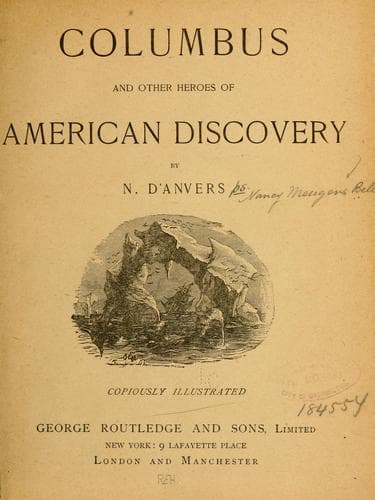
Columbus and Other Heroes of American DiscoveryD'Anvers, N.
History
Columbus and Other Heroes of American Discovery
D'Anvers, N.
America -- Discovery and exploration; North America -- Discovery and exploration
The change――as all great changes generally are――was gradual. The
pioneers of the new order of things often surprised some little group
of dusky half-caste children, with eager eyes and vivacious ways
of their French fathers contrasting strangely with the shrinking
timidity inherited from their savage mothers. Now and then, too,
bloody struggles took place between the hunters of the rival nations;
and the natives, delighted to see the white men devouring each other,
began those treacherous assaults, in which they have ever proved
themselves adepts, which culminated in the massacres of Detroit and
Michilimackinac.
This terrible transition stage, where such numerous rivals were
contending for the monopoly of the fur-trade of the great North-west,
produced, as transition stages so often do, many a bold spirit eager
to win honor by facing the exceptional difficulties of the time. First
one and then another hero came forward to offer his services to the
Hudson’s Bay Company for new expeditions; first one and then another
member of its infant rival accomplished some traveling-feat hitherto
looked upon as impossible. Some few among these, such as Hearne of the
Hudson’s Bay Company, and Mackenzie of the North-west Company, worked
below as well as above the 60th parallel of north latitude, and must
therefore be noticed here.
Illustration: AN ESQUIMAUX DWELLING.
Hearne, the first of this brilliant pair of adventurers to start, left
the western shores of Hudson’s Bay in November, 1769, and accompanied
by two Europeans and a number of Indian guides, struck across country
in a northerly direction, with the head-waters of the Coppermine River,
so named after the mine supposed to exist in its vicinity, as his goal.
Again and again compelled to retrace his steps to the advanced forts
of his employers, on account of the scarcity of provisions and the
extreme cold, our hero did not enter the great northern plain until
December, 1770. Across it he was now, however, conducted in safety by
an Indian guide, named Matonnabbe, who was accompanied by his eight
squaws, on whom the chief burden of providing for the comfort of the
party was thrown.
So well did these poor women fulfill their mission, turning to account
every scrap of food which came in their way, that Hearne reached in
safety the most southerly of the great hyperborean series of frozen
lakes. Naming the smaller ones Cossed, Snow-bird, Pike, Peshew, and
Cagead, he came in due course to the more important Athabasca, just
below the boundary line of the 60th parallel of north latitude, and
beyond that again to the Great Slave Lake, situated between N. lat.
60° and 63° and surrounded on every side by rugged wooded heights,
presenting a pleasing contrast to the white stretches of snow and ice
extending on every side beyond.
Public-domain text, read in full here on John Shaqi.
Reviews
Reviews
No reviews yet
Be the first to share your thoughts on this work.
Elsewhere in the archive
Join the Discussion
Join the discussion
Sign in to leave a comment or review.
Sign InorCreate an account