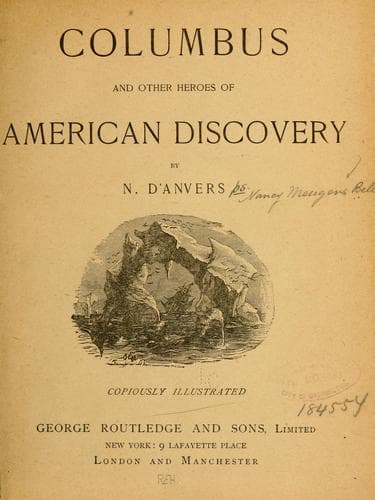
Columbus and Other Heroes of American DiscoveryD'Anvers, N.
History
Columbus and Other Heroes of American Discovery
D'Anvers, N.
America -- Discovery and exploration; North America -- Discovery and exploration
It was finally resolved that the head-waters of the Arkansas, the
largest affluent of the Mississippi after the Missouri, and of several
of its minor tributaries, should now be sought; and, with this end in
view, a south-westerly course was pursued along the eastern base of
the Rocky Mountain Chain. A weary march across the low, bare, sandy
plains of the present state of Wyoming, strewn with broken sandstone,
brought our heroes to the brink of the precipice dividing these lofty
table-lands from the valley of the Arkansas, where they were alike
cheered and tantalized by the sight of the river they were seeking,
flowing through a rich and fertile country.
It was now decided to divide forces; ♦Major Long and most of the men,
with all the heavy baggage, to go down the Arkansas to the Mississippi
and await the rest of the party at Fort Smith, while Captain James and
a few picked men should continue the explorations among the mountains.
The first part of the programme was duly carried out, the chief
discovery made being the existence of a number of chalybeate springs;
but much disappointment and delay attended Captain James and his party
in their wanderings among the then unknown tracts inhabited by the
Yutas and other wild tribes bordering on the Salt Lake territory, a
region about which a weird mystery clings even now.
♦ ‘Captain’ replaced with ‘Major’
Provisions and water alike ran short; the beds of streams, to which
the travelers hastened to quench their thirst, turned out to be
full of nothing but salt, and all efforts to find the source of the
Arkansas failed. At last a broad tributary, supposed to be the Red
River of the South, was discovered and followed, but it turned out
to be the Canadian, which joins the Arkansas before the confluence
of the latter with the Mississippi. The second half of the journey of
exploration may therefore be said to have practically failed, though
the way was paved by it for the colonists who, a few years later,
migrated to the districts traversed.
The whole party met again at Fort Smith on the Mississippi, and made
their way thence to the western coast by what had now become quite a
well-known track. Disgusted with the poor results obtained, however,
Major Long shortly afterward accepted the command of yet another
expedition, the aim of which was to explore the vast tracts watered
by the northern tributaries of the Mississippi, and which, though the
property of the United States, were as yet practically unknown.
Public-domain text, read in full here on John Shaqi.
Reviews
Reviews
No reviews yet
Be the first to share your thoughts on this work.
Elsewhere in the archive
Join the Discussion
Join the discussion
Sign in to leave a comment or review.
Sign InorCreate an account