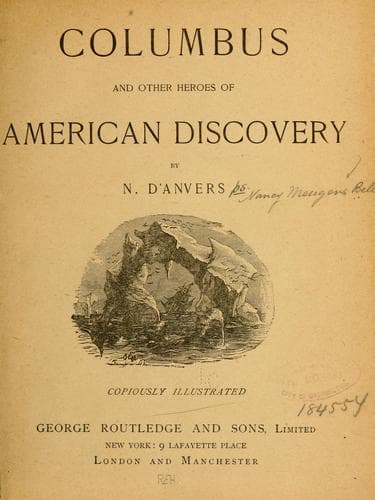
Columbus and Other Heroes of American DiscoveryD'Anvers, N.
History
Columbus and Other Heroes of American Discovery
D'Anvers, N.
America -- Discovery and exploration; North America -- Discovery and exploration
DURING the first years of the present century, the tide alike of
emigration and exploration had set toward the northern territories
of the United States. The discovery of the sources of the Mississippi
and of those of its chief affluents, however, left little more to be
done in that direction, and, in 1838, a new chapter in the history
of modern American geography was ushered in by the sending out of a
naval exploring expedition, under Captain Wilkes, with orders to make
surveys along the western coast, especially of the bay now known as
that of San Francisco.
On the arrival of Wilkes at Yerba Buena, as what has since become the
gate of the Pacific was then called, the town consisted merely of a
large frame building occupied by an agent of the Hudson’s Bay Company,
a store kept by an American, a billiard room and bar, a poop cabin of
a ship used as a residence by a captain, a blacksmith’s shop, and a
few sheds, all of which had sprung up at intervals since California,
deserted, as related above, by its early colonists, had become
the prey of trappers, miners, and other adventurers of various
nationalities.
The most prominent man then in California was a Swiss named Sutter,
who had bought of the Mexican Government a tract of land thirty
leagues square, and was now employed in laying it out under the
imposing name of New Helvetia. He had already built a fort near the
junction of the Sacramento and American rivers to which he had given
his own name, little dreaming that the discovery of gold close at
hand would shortly make that name world-famous, as the most powerful
emigration magnet of the day.
Equally unconscious of the approaching, almost miraculous change in
the aspect of affairs on the south-western coast of North America,
Wilkes completed his survey, and returned home to report the harbor
of Yerba Buena to be one of the finest, if not the very best in the
world; and, a little later, the Government sent out an expedition,
under Lieutenant John C. Fremont, to explore the southern half of the
Rocky Mountain Range, with a view to the discovery of a good route to
California.
Illustration: JOHN C. FREMONT.
Fremont left the mouth of the Kansas, at the head of a party of about
twenty, about the 2d of May, and followed its course across the state
of the same name, till he reached the barren banks of the Platte,
or Nebraska. Here he decided to follow the southern fork of that
important tributary of the Mississippi, and a march of a few miles
brought the party into the districts occupied by the Arapaho and
Cheyenne Indians, the former of whom at first appeared disposed to
dispute the passage of the white men.
Public-domain text, read in full here on John Shaqi.
Reviews
Reviews
No reviews yet
Be the first to share your thoughts on this work.
Elsewhere in the archive
Join the Discussion
Join the discussion
Sign in to leave a comment or review.
Sign InorCreate an account