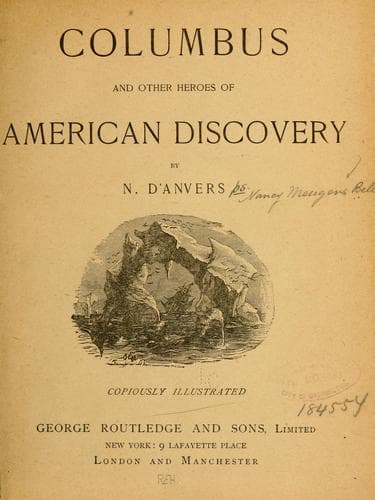
Columbus and Other Heroes of American DiscoveryD'Anvers, N.
History
Columbus and Other Heroes of American Discovery
D'Anvers, N.
America -- Discovery and exploration; North America -- Discovery and exploration
In 1848, the indefatigable Fremont made another journey to California,
this time at his own expense; but in attempting to cross the mountains
between the Rio Grande and the Colorado in the depth of winter,
his guide lost his way, and nearly all the men and animals died a
miserable death. Fremont himself escaped, but we have been unable
to obtain any record of his adventures, or of the geographical
discoveries made on this last trip, which, however, took place
after the discovery of gold near Sutter’s Fort and the admission
of California to the Union had completely revolutionized the aspect
of affairs.
CHAPTER XV.
TWO GREAT EMIGRATIONS.
SHORTLY after the discovery of the Great Salt Lake by Fremont, took
place that remarkable event in Illinois which led to the peopling
of the Great Basin with the Mormons, or Latter-day Saints, followers
of the so-called martyr, Joe Smith, who, thrown into prison for the
crimes he had committed in the name of religion, was murdered by
a band of roughs on the 29th June, 1844. The State of Illinois had
granted the Mormons lands, and they had lived long enough on them to
found the city of Nauvoo, in which they had built a huge and imposing
temple of polished marble.
After the murder of Smith, the original inhabitants of Illinois,
disgusted at the immoral practices of the Mormons, compelled them to
sell their property and leave the state. The Saints now resolved to
emigrate far away from all civilized communities, and to found a new
republic among the vast solitudes of the Rocky Mountains. Explorers
were sent out in different directions to choose the best locality for
the purpose, and their reports led to the selection of the Great Salt
Lake Valley. Westward then the emigrants, headed by their new prophet
Brigham Young, began to move, their exodus resembling that of the
Israelites from Egypt more than any of modern times.
In February, 1846, the Mississippi, then frozen over, was crossed, and
a journey of fifteen hundred miles, through a country without roads,
bridges, rivers, or wells, and peopled by wild bands of Pawnee and
Shoshone Indians, was commenced. Bravely, however, the multitudes
pushed on, and however we may condemn their peculiar tenets, we can
not withhold from them our admiration for the faith which braced them
up in what they looked upon as suffering for righteousness’ sake.
Still more must we honor the moral courage which, when the war broke
out between the United States and Mexico, led Young to send five
hundred of his sturdiest men to help their country in her hour of need,
the ranks of his followers closing up, when they were gone, to face
the now double dangers of the way, with no perceptible weakening of
resolution.
Public-domain text, read in full here on John Shaqi.
Reviews
Reviews
No reviews yet
Be the first to share your thoughts on this work.
Elsewhere in the archive
Join the Discussion
Join the discussion
Sign in to leave a comment or review.
Sign InorCreate an account