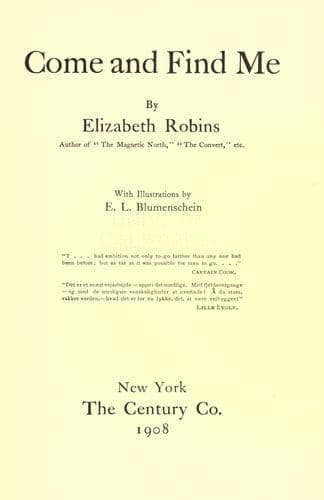
Alaska -- Fiction; California -- Fiction; Gold mines and mining -- Fiction
“I want your brothers to be what they call ‘knocked silly’ when they
first see you, Hildegarde. You must be all dressed and ready, and we can
turn up the bottom of the skirt and work at that last dragon while we’re
waiting.”
In pursuance of this plan, the two girls had gone up-stairs directly
after supper, though it was hardly probable the boys could get there
before half-past nine.
Mrs. Mar sat waiting for them in the parlor, on that side of the center
table where the book rest supported an open volume. She rocked while she
waited, and she crocheted while she rocked. At times she glanced at the
clock—not once at the open book. Not for her own edification was the
volume there, but for the enlargement of Hildegarde’s literary horizon,
while she and Bella stitched at silver dragons. But this latest choice
in standard works had not pleased any one. Victor Hugo was much too fond
of fiery love-scenes to prosper with Mrs. Mar, but the miserable man
had become a classic, and after all, Hildegarde was old enough not to
be infected. Bella—she read everything, the minx! Although Hildegarde
was in her twenty-fifth year, Mrs. Mar knew her so little, she felt no
assurance that the girl would keep up her languages, or read “the best
things” in any tongue, without her mother’s dragging her by main force
across the flowery fields of belles lettres—as though over stubble and
through brake.
Listening to Mrs. Mar’s reading of a classic was an experience of some
singularity. For if she macerated descriptive bits with a chin-chopper
despatch, to get them out of the way (not disguising the fact that she
considered these passages in the light of the salutary self-torture that
no disciplined life should evade, any more than vaccination or a visit
to the dentist), she did far deadlier things to scenes of sentiment or
passion. These she approached with a sturdy determination not to give
in to their nonsense, to make them at all events _sound_ like sanity by
sheer force of her own impregnable common-sense—a force so little to be
withstood, that it could purge the most poetic page ever written. It
made even Victor Hugo sound as reasonable as the washing list. If you
didn’t inwardly curse or secretly weep, you must have laughed to see how
effectually she could clip fancy’s wings, slam the door on sentiment,
bring high passion down to a sneaking shame, and effectually punish a
great reputation. In short, listening to Mrs. Mar reading romance was so
sure a way, not only to strip it bare of its traditional glory, but to
rob it of every chance of “going home,” that Hildegarde, as soon as she
got wind of what was the next work to be attacked, hastened to borrow it
of Bella, devoured it alone, and so got a first impression that could
more or less hold its own against the maternal onslaught. It is but
fair to say that to any comedy passage Mrs. Mar gave excellent effect,
and, by way of appreciation, a grim smile peculiarly her own; while for
Public-domain text, read in full here on John Shaqi.
Reviews
Reviews
No reviews yet
Be the first to share your thoughts on this work.
Elsewhere in the archive
Join the Discussion
Join the discussion
Sign in to leave a comment or review.
Sign InorCreate an account