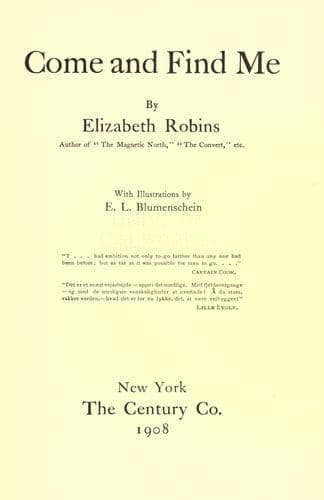
Alaska -- Fiction; California -- Fiction; Gold mines and mining -- Fiction
‘Aug. 29th.—Leidley made a wooden caisson and sunk it about 250
ft. beyond low tide, and got from fifteen to fifty cents per
shovel. I did not see this experiment, but I believe firmly
that the richest part of the beach is beyond low tide.
‘There will be more money come out from Nome than came from the
Klondike.’”
“Here’s a column headed—
“‘A REGION RICHER THAN PIPE-DREAMS
“‘Nome defies all theories and every precedent. Its greatest
mines have been found, and its greatest fortunes have been made
by men who knew nothing of mining. Gold has been discovered by
lawyers and doctors, dry-goods’ clerks, plow-boys, barbers,
fiddlers and politicians, in a thousand places where old
miners would have sworn, and did swear, it was impossible.
Millions of dollars in glittering dust and nuggets have been
thawed out of frozen rubble and moss, and washed from ocean
beaches and other unheard-of depositories by young divinity
students, country printers, piano professors and didapper
dandies, whom nobody ever suspected of knowing grindstones from
thousand-dollar quartz, or iron pyrites from free gold.’”
Mrs. Mar read on, intoxicating herself. “Here’s a woman who was up there
in the summer when the beach gold was found. She’s brought home $15,000,
and a claim she refused to take $38,000 for.”
But if there was anything about typhoid in the paper Hildegarde had
to find it out for herself. Little by little she knew that however
deterred her mother had been by Cheviot’s onslaught the spring before,
she was either consciously or unconsciously coming to look favorably on
Hildegarde’s old plan.
What the inexperience of the girl could not guess was that Mr. Mar’s
absence had taught his wife several things. And that lady had no
inclination to gather another year’s harvest of the bitter fruit. If
Hildegarde could get him to come home, Hildegarde ought to be supported
in spite of Cheviot and the boys. But real confidence between them was
so little easy, that the girl said nothing to her mother of her plan to
raise money by selling the beautiful necklace and the other things that
Bella had from time to time brought home to her from abroad. Hildegarde
would go to a man she could trust—“the family jeweler,” as they called
the individual whose high office had been to restore the pins to brooches
that Mrs. Mar’s energetic fingers had wrenched off, and to mend Mr. Mar’s
grandfather’s watch-chain when it broke, as it used, two or three times
every year.
To the family jeweler, then, Hildegarde took her box of treasures. “What
are they worth?”
The little man screwed a glass in his eye, and examined rare stones and
renaissance enamel with an omniscient air.
“I know you’ll do your best for me,” Hildegarde said anxiously.
“Of course—certainly, Miss Mar. Not very new, are they?”
“New! Oh, no—they’re so old they’re very valuable.”
“Yes. H’m. Yes.”
Public-domain text, read in full here on John Shaqi.
Reviews
Reviews
No reviews yet
Be the first to share your thoughts on this work.
Elsewhere in the archive
Join the Discussion
Join the discussion
Sign in to leave a comment or review.
Sign InorCreate an account