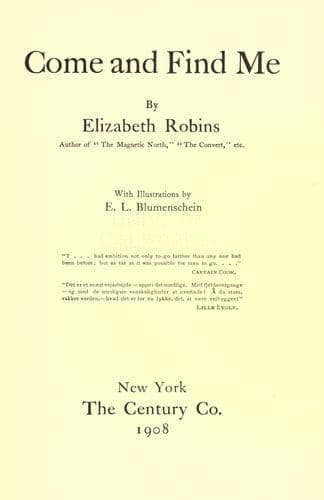
Alaska -- Fiction; California -- Fiction; Gold mines and mining -- Fiction
Hildegarde learned other things the next morning besides how to do your
marketing for two years in an hour. She brought away from Baumgarten’s
the renewed impression that Mrs. Blumpitty was a person of some practical
sense, and that Mr. Blumpitty, though he might be an authority upon
the Mother Lode and an estimable character to boot, did in reality
himself need a good deal of looking after. It is impossible to say just
how the “unlogical” feminine mind—in this case young and ignorant as
well—may arrive at so definite a conclusion out of a small assemblage
of apparently trifling data. For Hildegarde’s judgment was not founded
merely upon the outer man. Nor was it contributed to very largely by Mr.
Blumpitty’s indifference to small economies, as shown in his readiness
to order gallons of expensive “olive” when cotton-seed oil was as cheap
as wholesome to cook with, and Mr. Blumpitty convicted by his wife of
inability to detect any difference in taste. It was not merely that Mrs.
Blumpitty was the one to offer reasons why methylated spirit, though
cheap on the bill, was dearer in actual use than alcohol. It was not that
he had forgotten after sixteen months’ experience, “what a cravin’ you
get up there fur sweet and fur sour,” and what a failure the California
dried fruit had turned out the year before. _Had_ he complained he
couldn’t eat such insipid stuff till Mrs. Blumpitty had “livened” it with
a dash of vinegar as well as sugar and spice? Wa-al, p’raps he had!
“You mustn’t give me dried apples from any place nearer here than
Michigan,” said Mrs. Blumpitty.
The Baumgarten Brother had smiled a little, and said, “She knows.”
The upshot of the morning was to give Hildegarde an inkling that the
chief use of Mr. Blumpitty, so far as she was concerned, might be that he
would keep her family soothed by the illusion that this respectable man,
pledged to her service, was “going to see that everything was all right.”
For the rest, should she not perhaps do well to imitate his spouse, and
not expect any one to be wide awake in her interest who was half asleep
before his own? Although he had said, “Ya-as, it’s all right about the
ticket,” Miss Mar interviewed the steamship people on her own behalf.
“Quite right!” they indorsed Mr. Blumpitty’s account of the matter.
And as to the berths, Mr. Blumpitty already had twenty-eight, and had
sent word he wanted a twenty-ninth, “a pertickler good one fur a lady.”
“Noospaper woman I presoom,” said the agent politely. It seemed to be
only the press that inspired such respect. She was more glad than ever of
the offer that had come that morning from Eddie Cox, editor, now, of the
“San Miguel Despatch.” “Yes,” she told the agent, “I am to be a Regular
Correspondent.” In all sorts of ways she saw her status incomparably
improved by falling in with Eddie Cox’s suggestion. It appeared to be
necessary to stand well with a “noospaper” woman. “What accommodation can
I have?”
“Why, the best we got.”
Public-domain text, read in full here on John Shaqi.
Reviews
Reviews
No reviews yet
Be the first to share your thoughts on this work.
Elsewhere in the archive
Join the Discussion
Join the discussion
Sign in to leave a comment or review.
Sign InorCreate an account