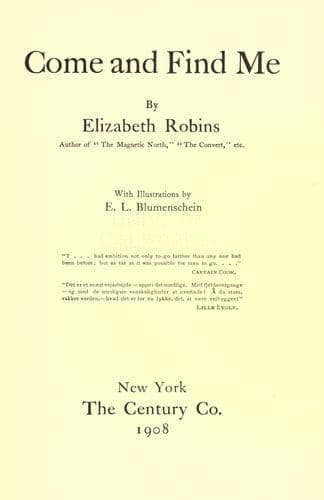
Alaska -- Fiction; California -- Fiction; Gold mines and mining -- Fiction
When Mrs. Blumpitty found herself being taken below that first evening,
she revived sufficiently to protest, and so frustrated the giant’s
amiable design of carrying her off to bed. The invalid stayed on deck day
and night, and instead of dying as the captain and all the passengers
confidently expected, she got well and “lived happy ever after” on that
voyage upon Miss Mar’s supplies, sharing even the fresh eggs which the
giant, by some means, acquired daily from the Nome-bound hens. Hildegarde
was sorry she lacked courage to share Mrs. Blumpitty’s new quarters.
But the “queerness” of sleeping out of your bed—in the public eye,
too!—almost the immodesty of it (in the passenger mind), if unpalliated,
as in Mrs. Blumpitty’s case, by threatened dissolution—no, it was too
daunting. Since Mrs. Locke could “stand it” in the cabin, Hildegarde
must. Even Mrs. Locke’s seamanship had gone down before the _Roumelia’s_
roll, but she was getting better. She made fitful appearances on deck.
But there was something odd about her. You never knew whether it was
sea-sickness or distrust of her kind that would carry her suddenly below
when a fellow-passenger stopped to speak to her.
Fresh from a raid upon the provision-box, Hildegarde coming on deck one
evening, found Mrs. Locke in an hour of clearing weather between showers.
There was even a strip of ruddy sunset to gladden the voyager’s heart.
Hildegarde looked round for her chair.
“It rained two drops a little while ago,” observed Mrs. Locke, “and the
man you call the giant moved your things.”
“Oh, did he?” Hildegarde stood at the ship’s side, looking at the fading
red.
By and by, “Sit on half my stool,” suggested Mrs. Locke.
“Thank you,” said Hildegarde, feeling that coming from such a source this
invitation was immensely cordial. “It’s very kind of you.”
“No, that isn’t it.”
“What do you mean?”
“You’re the sort of person everybody wants to do things for.” She seemed
to point it out as a fault on Miss Mar’s part.
Hildegarde looked at her curiously. “I should have thought _you_ were
more that kind of person, except for—” The cameo-like face must have been
beautiful before it grew so white and set. You felt that a touch of color
even now, a little happiness, would make it irresistible.
“Except?” Mrs. Locke echoed.
“Well, you know you _do_—Shall I say it?”
“Yes.”
“You do receive friendliness a good deal at the point of the sword.”
“I’ve learnt my lesson.” As Hildegarde said nothing, “Wait till _you_
are—” But any inclination to be more explicit vanished.
Hildegarde thought she had intended to say, “Wait till you’re as old as
I.” “I have a feeling you know immensely more than I do,” said the girl,
“but I don’t believe you’re much older.”
“I’m thirty-two.”
“Well, I’m twenty-six.”
“You don’t look that much.”
“I suppose it’s having eyes so wide apart.”
Public-domain text, read in full here on John Shaqi.
Reviews
Reviews
No reviews yet
Be the first to share your thoughts on this work.
Elsewhere in the archive
Join the Discussion
Join the discussion
Sign in to leave a comment or review.
Sign InorCreate an account