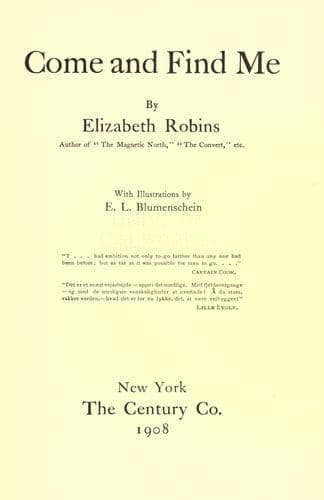
Alaska -- Fiction; California -- Fiction; Gold mines and mining -- Fiction
“But we didn’t call ourselves arctic explorers, and we never once said
Pole—not even after we reached the edge of the ice-pack, north of
Sannikof Island. It wasn’t till we got into north latitude 78° that we
called a council of war. By that time we knew our men and they knew us.
We were sure of six, but we put it to the other four as well. We engaged
to extricate the ship from the floe and send her home, if any man of
them wanted to turn back. What were Borisoff and I going to do? one of
the doubtful four asked. Well, we had our famous steel launch, and we
had sledges, dogs, kyacks, provisions, and—we had—an idea we’d like to
see what it was like—_farther on_. I’ve always believed our not saying
anything about ‘a dash,’ or so much as naming the great goal, gave
Borisoff’s words their most compelling eloquence. If we’d said then that
we wanted to try for the Pole, some one would have felt himself obliged
to object and talk prudence. As it was, we twelve sat there as one man in
the little saloon of the _Narwhal_, with the loose ice grinding against
the ship’s sides. And no one said, but every one was thinking, ‘We’ll
find the Pole.’ Borisoff was a born leader. Not a soul on the ship but
believed Borisoff would do anything he set out to do. They all knew by
now how extraordinarily well equipped we were. Borisoff showed again and
again how we should profit by the failure of our forerunners. Well, that
was in September. We were frozen in, and we drifted with the ice all that
winter and following summer—drifted in the dark, with bears prowling
round the ice-shrouded ship—drifted in the midnight sun with guillemots
and fulmars circling about our rigging.”
He sat there some seconds staring through the peat wall, never seeing the
open watch, forgetting the irrevocable hour. As though she, too, shared
in some chill vision, the dog shivered.
To bring the master back, “Ky is cold,” said Hildegarde, and would have
thrown over her a trailing end of blanket.
“No, no, she’s not cold _here_,” the sick man answered, but in a voice so
faint and far Hildegarde wondered if he would ever speak again.
To mask her creeping fear and bridge the silence, “Why does she shiver,
if she’s not cold?”
His absent eyes came slowly back to where the dog was uneasily dozing.
“Thinks we’re crossing the ice-moraines, thinks she can’t go on, then
remembers the whip. The whip that flies out when you least expect it,
eh, Ky?—and bites the hair off clean.” He bent forward, and gently laid
his distorted hands on the scarred and trembling hide. The dog was quiet
again.
“That first winter,” he went on, “one of our men was killed by a bear,
and one died from a natural cause. He would have died at home. Early in
the summer came the day when the ice gripped us. Our tough ship might
have been an egg-shell. But we were ready.”
“You had to abandon her?”
Public-domain text, read in full here on John Shaqi.
Reviews
Reviews
No reviews yet
Be the first to share your thoughts on this work.
Elsewhere in the archive
Join the Discussion
Join the discussion
Sign in to leave a comment or review.
Sign InorCreate an account