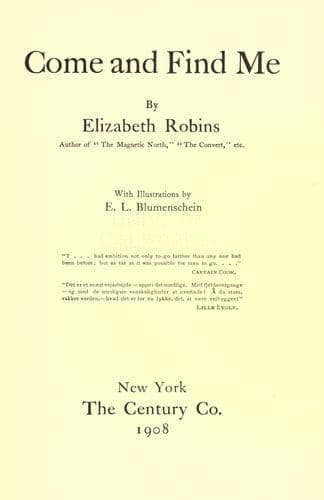
Alaska -- Fiction; California -- Fiction; Gold mines and mining -- Fiction
Hildegarde’s soreness of heart, her hopelessness of the greater
gladness for herself, left her the freer to think of it as only half an
achievement—this bringing her father back in the flesh. She must see
his spirit “at home” before her task was ended. No discreet opportunity
was lost to set her mother in an explanatory light. When the neighbors
chorused admiration of the girl’s pluck and resourcefulness on the great
journey, oh-ing and ah-ing, and “How on earth did you manage?”—“It was
never the least difficult,” Hildegarde would interrupt. “When I was at a
loss I always thought how my mother would take hold of the matter, and
when I had imagined her into my perplexity it wasn’t a perplexity any
longer. I saw just what she would do, and I saw it was just right.”
Only once, with her father alone, did she venture openly to suggest a
corrected judgment of the past.
They had been talking of Mrs. Locke. Mar, who had failed so signally
in getting a post for himself, had succeeded in getting one for his
daughter’s friend.
“You _have_ been good about it!” Hildegarde said. “I’m so grateful. So is
she.”
“So is the firm. She’s a success.”
“It just shows!”
“Shows what?”
“That the reason women aren’t more use in the world is because they don’t
have a chance.”
“H’m!” said Mr. Mar.
“No. Not a real chance, father.”
“Good heaven! They have everything.”
“No. They don’t have education. I don’t mean out of books. It’s just as
Mrs. Locke says. They stand as little chance of knowing about life as
kings and queens do. They are still a class apart.”
“Oh, she talks like that—your Mrs. Locke?” said Mar, with an obvious
uneasiness.
“Not of herself. Of the rest of us—unless”—she smiled—“unless we’ve been
to Nome; or, like mother, to Mecca.”
“To Mecca?”
With a face more serious the girl went on: “I’ve only just begun to
notice who among the women I know are the most successful and the most
sensible. They’re the ones that have had the most experience, gone about
most, or”—her voice sunk—“had some great trouble, _known_ about life
somehow by knocking up against it. It looks as if the only way to get
judgment is by having to judge. Men, of course—you’re always practising.
You’re _in_ things. You aren’t an outsider.”
“Who is an outsider?”
“Every woman, when she comes out of her own front door. Now”—before he
could answer she hurried on—“now, there’s mother” (she spoke as if she
had only just remembered her). “A clever person like mother—why, if she’d
had ten times as much to do, she’d have done it ten times better. And she
wouldn’t have had time to think about—a—the cracks in the china. Yes,
father, you may depend upon it, it’s the women that haven’t got much in
them that fit best into the small places. Mother’s always been crowded.”
Public-domain text, read in full here on John Shaqi.
Reviews
Reviews
No reviews yet
Be the first to share your thoughts on this work.
Elsewhere in the archive
Join the Discussion
Join the discussion
Sign in to leave a comment or review.
Sign InorCreate an account