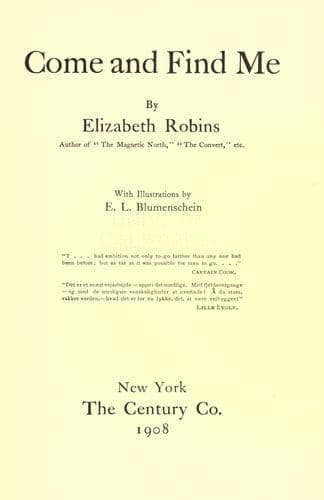
Alaska -- Fiction; California -- Fiction; Gold mines and mining -- Fiction
It was a long time since his wife had given him the credit for doing more
than his share at the bank with a view to promotion to be head cashier,
or even a “silent partner.” Each time a vacancy occurred some one else
had stepped into it; Louis Cheviot had been the last. But Mrs. Mar
learned through the years that the reason her husband accepted increased
tasks was that he was born to bear burdens, as the sparks to fly upward.
If any extra work was “going,” so to speak, it gravitated unerringly to
Nathaniel Mar. As to the question of his reward, what would be gained by
giving a better position to a man who in any crisis could be depended
on to do all the work of a higher office, and never ask for increased
emolument? The only person who ever hinted such a thing to the Trennors
had been Cousin Harriet. The Trennor Brothers’ success (which was
proverbial in Valdivia) had long extended to avoidance of Cousin Harriet.
Certainly Mr. Mar’s life-long ill-luck brought out more clearly the fact
of his boys’ early prosperity. Not that it was enormous as yet, though
quite sufficient to have enabled them to marry, had they so chosen.
Mrs. Mar’s satisfaction in her sons was checkered by the fact that each
of these otherwise reasonable and enterprising young men clung to his
boyish infatuation for Bella Wayne, long after their boyhood had gone
the way of the years. It certainly did seem as though not till one or
both were cut out by her marrying some one else, would either Trenn or
Harry look at any of the girls Mrs. Mar considered more desirable. Not
that the boys’ mother had been able wholly to escape the general Mar
devotion to the disturber of their peace, but as the seasons passed, and
Bella rejected one swain after another, it became increasingly vexatious
to Mrs. Mar that her sons should not realize and amend the stupidity
of caring about a girl who was more and more under suspicion of being
handicapped by a silly passion for a mad fool who had given up the
substance for the shadow, and had met his due reward—being now these many
months lost in the arctic ice.
* * * * *
Hildegarde’s theory that since the unhappy issue of the love affair,
Bella had greater need of her friend than ever before, and Hildegarde’s
own consequent inaccessibility to others was the cause of some
restiveness on Cheviot’s part. His old friendliness for Bella had
vanished. He spoke of her with a humorous disparagement that did him
ill-service with Hildegarde. But he was grave enough sometimes.
“I never get a word alone with you, nowadays,” he said one night, as he
sat smoking on the steps of the porch at Hildegarde’s feet, while Bella
walked about the garden with Trenn. Hildegarde made some perfunctory
answer, and they sat silent for a time.
Public-domain text, read in full here on John Shaqi.
Reviews
Reviews
No reviews yet
Be the first to share your thoughts on this work.
Elsewhere in the archive
Join the Discussion
Join the discussion
Sign in to leave a comment or review.
Sign InorCreate an account