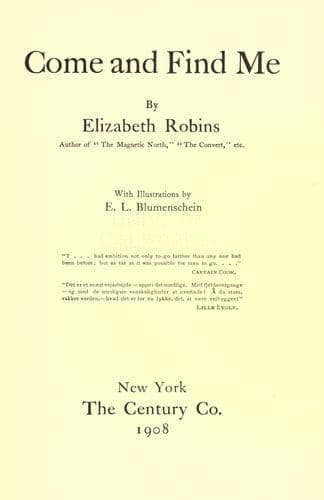
Alaska -- Fiction; California -- Fiction; Gold mines and mining -- Fiction
“It isn’t that I couldn’t forgive you for not being in love with me,”
he said. “But for being in love with a photograph and a packet of
letters—_no!_ that wasn’t easy. At the same time I knew well enough that
if your life hadn’t been so narrow, you wouldn’t have been so at the
mercy of this one romantic figure in it. If you’d been able to travel,
or even to go to the university—if you’d had _any_ other door open, you
wouldn’t have looked so long out of that one window.”
A scrap of one of Mrs. Browning’s letters flew across her mind—the dearer
somehow for being a little incoherent, not fitted together at all, yet
finely consequent to the inner spirit—those words: “The pleasantest place
in the house is the leaning out of the window.”
Ah, it was very true of the Mar house.
“And your mother,” Cheviot went on, “always ready to puncture any
home-blown bubble with the needle of her wit; mercilessly critical, for
fear her children should have too low standards; ready to flay anybody
alive in the cause of education. Never letting you rest satisfied for
a moment with the attainable—you must always be reaching out—reaching
out—and when you reached out you touched Galbraith.”
How strangely well he knew—this man. It was odd, but she could never
again think him obtuse, at any rate. That comfort was gone.
“I was even sorry for you while the engagement lasted,” the low voice
went on, unmindful of the uneasy stir of the figure sitting above him in
the dusk. He took the half-smoked cigar from his lips and laid it by the
pillar. Over the edge of the porch the tip shone red. “I saw how hard it
was for you; you had been weaving romances round Galbraith for years—you
had looked upon him for so long as your special property—” Hildegarde
drew back into the deeper shadow. But by his own suffering urged to win
a companion in pain, he persisted: “And you thought if it had been _you_
he had met, it would have been you that he—” Hildegarde’s skirts rustled
as if she were getting up—“Look here, I’ve told you before you’ve got a
genius for truth—I’m treating you on that basis.” She said nothing, but
she sat still. “There was a moment,” Cheviot’s voice was unnaturally low,
“last spring, when I knew I was gaining ground with you. It was the
day I came back from Mexico. I came here straight from the station, and
you—you—” She heard him strike his hands suddenly together in the dusk,
and a curious excitement took hold of her. “When I went home, I found the
invitation to Bella’s wedding. It had been lying there for days. Then I
understood. You had had all those days and nights to get accustomed to
realizing it was the end of the old—where are you going? Can’t you even
bear to have me speak of it this once!”
The white figure was still again.
Public-domain text, read in full here on John Shaqi.
Reviews
Reviews
No reviews yet
Be the first to share your thoughts on this work.
Elsewhere in the archive
Join the Discussion
Join the discussion
Sign in to leave a comment or review.
Sign InorCreate an account