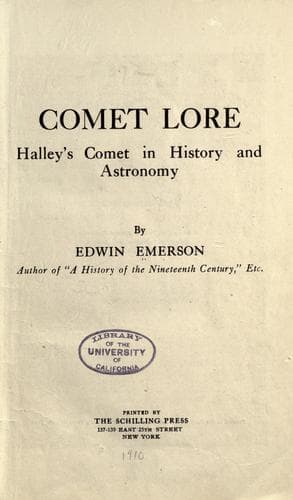
Comet Lore: Halley's Comet in History and AstronomyEmerson, Edwin
History
Comet Lore: Halley's Comet in History and Astronomy
Emerson, Edwin
Comets; Halley's comet
So much is certain. A collision of the Earth with a Comet will
undoubtedly prove disastrous—how disastrous will depend largely on the
size of the Comet’s head and on its speed. That a violent heat will
be developed, we have every reason to believe, from our knowledge of
meteors. The mere movement of a meteor through the thin upper layers of
our atmosphere produces a dazzling trail and reduces the meteor itself
to a molten metallic mass. Arrest a body in swift motion, and you must
dissipate its energy in some way. As a rule, the energy is converted
into heat. A bullet discharged from a rifle is often melted when
suddenly stopped by steel armour. A Comet travels at a pace compared
with which a projectile, fired from the most powerful twelve-inch gun,
seems only to crawl. What, then, must be the frightful effect when it
strikes the Earth?
A Comet rushes through space not at the bullet’s rate of thousands of
feet an hour, but of a million miles an hour. The bigger it is, and the
faster it moves, the greater will be the heat developed by its stoppage.
“At the first contact with the upper regions of the atmosphere,” writes
Prof. Simon Newcomb, “the whole heavens would be illuminated with a
resplendence beyond that of a thousand Suns, the sky radiating a light
which would blind every eye that beheld it, and a heat which would melt
the hardest rocks.” The same conclusion was reached by Prof. Faye.
When the time comes for a collision with a Comet of formidable size,
the human race will be in the horrible predicament of knowing the exact
hour and minute of its doom. The newspapers will print a dispatch from
some great observatory, reading perhaps like this:
“A telescopic Comet was discovered by Caxton in right ascension 7 hours
13 minutes 1 second, and declension 17 degrees 28 minutes 31 seconds.
Moderate motion in a northwest direction.”
[Illustration: “If so large a body with so rapid a motion were to
strike the Earth—a thing by no means impossible—the shock would
reduce this beautiful world to its original chaos.”—EDMUND HALLEY.]
At first the discovery produces not even a ripple of excitement.
Telescopic Comets are discovered too frequently. Three days later the
discoverer has worked out an ephemeris, which gives the date when the
body will pass around the Sun, and which indicates the Comet’s path. He
finds that on a certain date and at a certain hour the Earth and the
Comet must crash together. Again and again he repeats his calculations,
hoping that he may have erred. The utmost permissible allowance for
accelerations and retardations caused by the outer planets of the solar
system fails to change the result.
Public-domain text, read in full here on John Shaqi.
Reviews
Reviews
No reviews yet
Be the first to share your thoughts on this work.
Join the Discussion
Join the discussion
Sign in to leave a comment or review.
Sign InorCreate an account