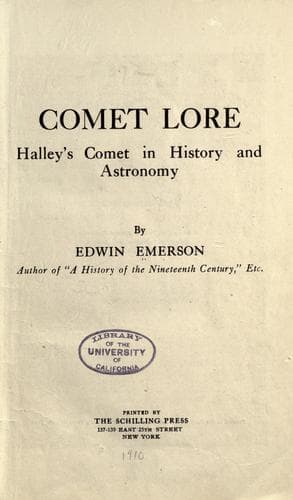
Comet Lore: Halley's Comet in History and AstronomyEmerson, Edwin
History
Comet Lore: Halley's Comet in History and Astronomy
Emerson, Edwin
Comets; Halley's comet
Illuminating gas, as we all know, is poisonous. If a Comet’s tail were
dense enough, it is conceivable, therefore, that every human being on
this planet might be asphyxiated by breathing the Comet’s poisonous
vapour as the Earth plowed through it. There is also this possibility,
suggested by Flammarion, that the gases of a very dense tail might so
combine with the nitrogen which constitutes nearly 80 per cent. of
the air we breathe, that the atmosphere would be converted into the
“laughing gas” employed by dentists. The world would die in a delirium
of joy. At first a delightful serenity would settle upon mankind. Then
would follow a contagious gaiety, febrile exaltation, a paroxysm of
delight, and then madness. Flammarion even conceives the world merrily
dancing a joyous, hysterical sarabande in which it perishes laughing.
The tail of a Comet is fraught with still other possible dangers. Our
atmosphere contains a certain amount of hydrogen, a marvellously light
gas to which balloons owe their buoyancy. Besides its lightness, this
gas is characterized by an extreme inflammability. The law of the
diffusion of gases teaches us that part of this hydrogen in the air
is mechanically mixed with other gases, and that part of it probably
floats in the upper air, far beyond the reach of any balloon. A Comet
may be regarded as a huge lighted torch whirling through space, which
may be brought dangerously near that upper layer of highly inflammable
hydrogen. If the gas shall ever be touched off by this flying torch,
our planet will be ignited. The whole atmosphere will become a seething
ocean of flame, in which forests and cities will burn like straw, in
which oceans will boil away in vast clouds of steam, and in which all
animal life will be snuffed out of existence before it shall realize
that the world is on fire. In a word, the globe will become a planetary
funeral pyre. Since water results from burning hydrogen in oxygen,
this same fierce and terrible flame must be speedily extinguished by a
mighty deluge which will engulf the Earth.
A spectroscope analysis of Halley’s Comet has furthermore revealed
the presence of cyanogen gas in the tail. Cyanogen is a compound of
nitrogen and carbon, one of the most poisonous compounds with which the
chemist is familiar. Prussic acid, potassium cyanide and many other
cyanides, all of them almost instantaneously fatal if taken into the
human system, are compounds of cyanogen. If that gas is present in
large enough quantities, one flick of a Comet’s tail will end all human
and animal existence.
Public-domain text, read in full here on John Shaqi.
Reviews
Reviews
No reviews yet
Be the first to share your thoughts on this work.
Join the Discussion
Join the discussion
Sign in to leave a comment or review.
Sign InorCreate an account