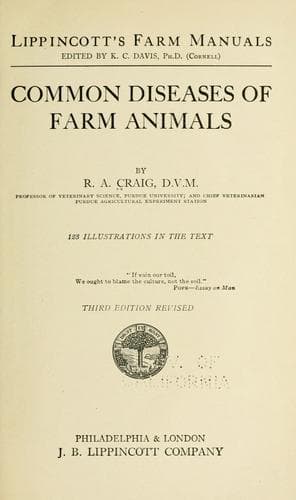
Common Diseases of Farm AnimalsCraig, Robert Alexander
Science
Common Diseases of Farm Animals
Craig, Robert Alexander
Veterinary medicine
_The operation is very simple_. The horn should be cut off at a point from
one-quarter to one-half an inch below the hair line or skin. If this is not
practised, an irregular horn growth or stub of horn develops. It is usually
unnecessary to apply anything to the wound. If the animal does not strike
or rub the part, the clot that forms closes the blood-vessels and the
haemorrhage stops. In case of haemorrhage of a serious nature, a small
piece of absorbent cotton may be spread over the surface of the wound, and
pushed in to the opening in order to keep it in place. Pine tar may be
smeared over this dressing. Some operators prefer cauterizing the wound
with a red-hot iron for the purpose of preventing haemorrhage. During warm
weather, the wound should be washed daily with a two per cent water
solution of a coal tar disinfectant, until healing is well advanced. A very
necessary after-treatment is the washing of the part after two or three
days for the purpose of removing the dried blood.
The opening at the base of the horn communicates directly with the frontal
sinus, a large cavity situated between the two plates of the frontal bone.
Sometimes the bone is slivered, or the wound becomes infected and inflamed.
This may be due to a dirty dehorning saw, or getting dirt into the wound.
The inflammation may extend to the sinus and a heavy discharge from the
cavity occur. This complication may be prevented by placing the saw or
cutters in a disinfectant when not in use, and cleaning and disinfecting
the wound very carefully for a few days after the operation.
_The horn buttons of calves_ from a few days to one week of age can be
destroyed, and the growth of the horn prevented by applying caustic soda or
potash to them. The method of procedure is as follows: Clip away the hair
from around the base of the horn tissue and apply a little vaseline to the
skin near, but not close to, the base of the horn; moisten the horn button
and rub it two or three times with the end of the stick of caustic; do not
allow the calf to go out in the rain for a few days after applying the
caustic. The horns of calves a few weeks of age may be removed with a sharp
knife or calf dehorner.
CHOKING.--This is a common accident in cattle and horses. The object that
causes the choke may be lodged in the pharynx or oesophagus. Certain
individuals are more prone to choke while feeding than others. This is
because of their habit of eating greedily, and swallowing hastily without
properly mixing the bolus with the saliva. For this reason, choking occurs
when the animal is eating dry feed. Cattle frequently become choked on
pieces of such food as roots and apples that are too large to readily pass
down the oesophagus. Sharp objects taken in with the food sometimes become
lodged in the oesophagus or pharynx.
Public-domain text, read in full here on John Shaqi.
Reviews
Reviews
No reviews yet
Be the first to share your thoughts on this work.
Elsewhere in the archive
Join the Discussion
Join the discussion
Sign in to leave a comment or review.
Sign InorCreate an account