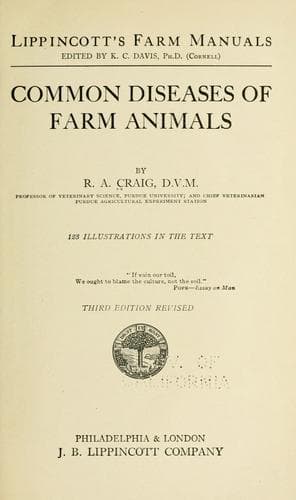
Common Diseases of Farm AnimalsCraig, Robert Alexander
Science
Common Diseases of Farm Animals
Craig, Robert Alexander
Veterinary medicine
The spring, early summer and fall are the most suitable seasons for
castrating the young. It may be practised during the hot or cold months of
the year with little danger from wound infection or other complications,
providing the necessary after-attention can be given.
_The preparation of the animal_ for the operation by withholding all feed
for about twelve hours is very advisable. If this is practised, the stomach
and intestines are not distended with feed, and the young are cleaner,
easier to handle and suffer less from castration. Clean quarters and
surroundings are very necessary to the success of the operation.
_The instruments required_ are sharp knives, preferably a heavy scalpel and
a probe-pointed bistoury, an emasculator for large and mature animals, and
surgeon's needles and suture material. Ropes and casting harness are
frequently used for confining and casting the large and mature animals. Two
clean pans or pails filled with a two per cent water solution of liquor
cresolis compositus, or an equally reliable disinfectant, should be
provided for cleaning the scrotum and neighboring parts and the
instruments. Pieces of absorbent cotton or oakum may be used in washing and
cleaning the scrotum. The instruments should be sterilized in boiling water
before using.
_If a number of pigs or lambs_ are to be castrated, it is best to confine
them in a small, clean, well-bedded pen. This enables the attendant to
catch them quickly and without unnecessary excitement or exercise. They
should be taken to an adjoining pen to be castrated. The scrotum should be
washed with the disinfectant, and the testicles pressed tightly against the
scrotal wall. An incision parallel with the middle line or raphe and a
little to one side is made through the skin and the coverings of the
testicle, and the testicle pressed out through the incision. The testicle
and cords are then pulled well out and the cord broken off with a quick
jerk and twist, or scraped off with a knife. The latter method is to be
preferred in large lambs if the operator does not have an emasculator. The
incision in the scrotum should be extended from its base to the lowest
part, in order to secure perfect drainage.
_Young calves_ may be castrated in the standing position or when cast and
held on the side. The method of operating is the same as recommended for
pigs and lambs.
_The castration of the colt_ may be performed in either the standing
position or when cast. The method of operating is the same as practised in
the smaller animals with the exception of cutting off the cord. The
emasculator is used here. This instrument crushes the stump of the cord and
prevents haemorrhage from the cut ends of the blood-vessels. Careful
aseptic precautions must be observed in operating on colts, as they are
very susceptible to wound infection and peritonitis.
Public-domain text, read in full here on John Shaqi.
Reviews
Reviews
No reviews yet
Be the first to share your thoughts on this work.
Elsewhere in the archive
Join the Discussion
Join the discussion
Sign in to leave a comment or review.
Sign InorCreate an account