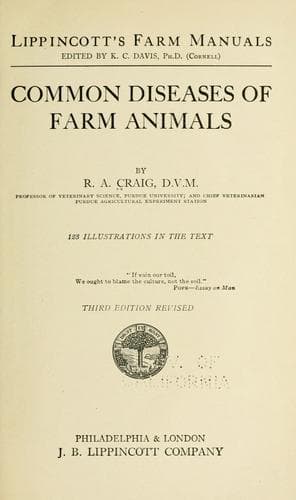
Common Diseases of Farm AnimalsCraig, Robert Alexander
Science
Common Diseases of Farm Animals
Craig, Robert Alexander
Veterinary medicine
_The treatment_ is both preventive and medicinal. The preventive treatment
consists in giving young, growing animals the best care possible.
Cleanliness about the stable, giving the colt plenty of range when running
in a pasture, and feeding a ration that is sufficient to keep the colt in
good physical condition are the important preventive measures. Tartar
emetic in one-half to one dram doses may be given with the feed daily until
five or six doses are given. Turpentine may be given in one to three ounce
doses in a pint of linseed oil. This may be repeated daily for two or three
days. Worms located in the posterior bowel may be removed by rectal
injections of a weak water infusion of quassia chips. The rectum should be
first emptied with the hand, and the nozzle of the syringe carried as far
forward with the hand as possible. The injections should be repeated daily
for several days.
INTESTINAL WORMS OF CATTLE.--Intestinal worms seldom cause serious losses
from unthriftiness or death in cattle. It is in calves only that we are
called on to treat this class of disease. The symptoms resulting from the
invasion of the intestinal tract by the different worms vary in severity
according to the number, habits of the parasite and care that the animal
receives. The usual symptoms are unthriftiness, indigestion, diarrhoea and
a stunted, anaemic condition. Stiles reported extreme anaemia,
unthriftiness and many deaths among cattle in a certain section of Texas,
due to extensive infection with the _Uncinaria radialus_.
_The treatment_ is largely preventive. Calves and yearlings should be
provided with plenty of feed at all seasons of the year. Good care and
careful feeding will keep them in a thrifty, healthy condition and enable
them to throw off invasions of intestinal worms. Turpentine is the
vermifuge usually administered to calves. The dose is from two to four
drams given in a milk or raw linseed oil emulsion.
STOMACH WORM OF SHEEP.--The twisted stomach worm, _Haemonchus contortus_,
is the most injurious internal parasite of sheep. It is a very small,
hair-like worm from 0.4 to 1 inch (9 to 25 mm.) in length. In the adult
form it attaches itself to the mucous membrane of the fourth stomach or
abomasum, and lives by sucking blood. The blood present in the digestive
tract of the worm gives it a brown color, and the white oviducts which are
wound around the digestive canal cause the body to appear twisted. When the
twisted stomach worm is present in large numbers, the worms become mixed
with the contents of the stomach and can be readily found on making a
post-mortem examination.
Public-domain text, read in full here on John Shaqi.
Reviews
Reviews
No reviews yet
Be the first to share your thoughts on this work.
Elsewhere in the archive
Join the Discussion
Join the discussion
Sign in to leave a comment or review.
Sign InorCreate an account