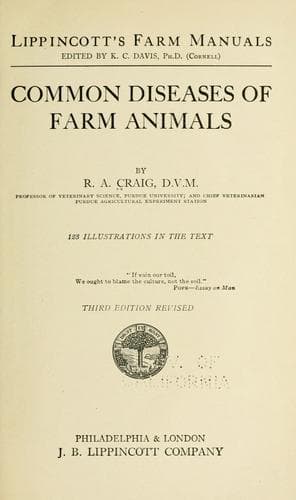
Common Diseases of Farm AnimalsCraig, Robert Alexander
Science
Common Diseases of Farm Animals
Craig, Robert Alexander
Veterinary medicine
_The treatment_ of lung-worm diseases in lambs and calves is largely
preventive. We should use every possible precaution against introducing the
infection into the herd or flock. It is not advisable to bring animals from
an infected herd onto the premises, without subjecting them to a careful
examination and a long quarantine before allowing them to stable or pasture
with the other animals. Calves or lambs that show marked symptoms of
disease should be given comfortable quarters, and special care and feeding.
The entire herd or flock must be given the best care and ration possible.
This is the only satisfactory method of treatment. Changing the pasture or
lot frequently may help in ridding the premises of the infection.
VERMINOUS BRONCHITIS IN HOGS.--The lung worm, _Strongylus paradoxus_, is a
common parasite of young hogs. It is from 0.6 to 1.6 inches (16 to 40 mm.)
long. When the infection is light, the worms are found mostly in the
bronchial tubes of the margin and apex of the lung.
Infection with this parasite does not depend on the humidity of the soil,
or low, wet pastures containing ponds. Probably dusty quarters are
responsible in large degree for this disease.
_The symptoms are most evident_ in pigs weighing from forty to eighty
pounds. The first symptom is a cough, occurring on leaving the bed, after
exercise and after eating. In badly infected cases the paroxysm of coughing
is quite severe. The appetite usually remains good and the thriftiness of
the pig is not seriously interfered with. The feeding of a suitable ration,
and the good care that is usually given young hogs, are responsible for the
mildness of the disease.
The treatment that is of most importance is clean quarters, and the feeding
of a ration that will keep the pig growing and healthy. The sleeping
quarters should be kept free from dust. Disinfectants should be used freely
about the quarters.
THE KIDNEY WORM OF HOGS.--_Sclerostoma pinguicola_ is the kidney worm of
hogs. It is from 1 to 1.5 inches (25 to 27 mm.) long, and when seen against
the kidney fat it appears dark or mottled. It is usually found in the fat
in the region of the pelvis of the kidney. Although the kidney worm is
capable of causing inflammatory changes in the tissues surrounding the
kidney and the pelvis of this organ, the disease cannot be determined by
any noticeable symptom. Paralysis of the posterior portion of the body is
attributed to the presence of kidney worms by stockmen. There are no data
by which we may prove that the kidney worm is responsible for this
disorder.
_The treatment_ is preventive. Clean feed, pens, watering troughs and
feeding floors are the preventive measures indicated here. It is useless to
attempt treatment with drugs, as the worms are out of reach of any drug
that may be administered.
Public-domain text, read in full here on John Shaqi.
Reviews
Reviews
No reviews yet
Be the first to share your thoughts on this work.
Elsewhere in the archive
Join the Discussion
Join the discussion
Sign in to leave a comment or review.
Sign InorCreate an account