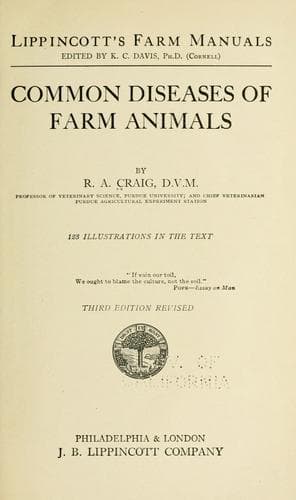
Common Diseases of Farm AnimalsCraig, Robert Alexander
Science
Common Diseases of Farm Animals
Craig, Robert Alexander
Veterinary medicine
_The larynx_ may be compared to a box open at both ends. The several
cartilages that form it are united by ligaments. It is lined by a mucous
membrane. The posterior extremity is united to the first cartilaginous ring
of the trachea. The anterior opening is closed by the epiglottis. Just
within is a V-shaped opening that is limited laterally by the folds of the
laryngeal mucous membrane, the vocal chords.
_The trachea_ is a cylindrical tube originating at the posterior extremity
of the larynx, and terminating within the chest cavity at a point just
above the heart in the right and left bronchial tubes. It is formed by a
series of cartilaginous rings joined together at their borders by ligaments
and lined by a mucous membrane.
_The bronchial tubes_ resemble the trachea in structure. They enter the
lungs a short distance from their origin, where they subdivide into
branches and sub-branches, gradually decreasing in calibre and losing the
cartilaginous rings, ligaments and muscular layer until only the thin
mucous membrane is left. They become capillary in diameter, and finally
open into the infundibula of the air cells of the lungs.
_The lungs_ take up all of the space in the thoracic cavity not occupied by
the heart, blood-vessels and oesophagus. This cavity resembles a cone in
shape that is cut obliquely downwards and forward at its base. The base is
formed by the diaphragm which is pushed forward at its middle. It is lined
by the pleura, a serous membrane, that is inflected from the wall over the
different organs within the cavity. The median folds of the pleura divide
the cavity into right and left portions. A second method of describing the
arrangement of the pleura is to state that it forms two sacks, right and
left, that enclose the lungs. The lungs are the essential organs of
respiration. The tissue that forms them is light, will float in water, is
elastic and somewhat rose-colored. Each lung is divided into lobes, and
each lobe into a great number of lobules by the supporting connective
tissue. The lobule is the smallest division of the lung and is formed by
capillary bronchial tubes, air cells and blood-vessels. It is here that the
external respiration or the exchange of gases between the capillaries and
the air cells occurs.
VENTILATION.--It is agreed by all persons who have investigated the
subject, that unventilated stable air is injurious to animals. At one time
it was believed that the injurious effects resulting from the breathing of
air charged with gases and moisture from the expired air and the animal's
surroundings, were due to a deficiency in oxygen. It is now believed that
the ill-effects are mainly due to the stagnation of air, the humid
atmosphere, and the irritating gases emanating from the body excretions.
Public-domain text, read in full here on John Shaqi.
Reviews
Reviews
No reviews yet
Be the first to share your thoughts on this work.
Elsewhere in the archive
Join the Discussion
Join the discussion
Sign in to leave a comment or review.
Sign InorCreate an account